



Ecommerce returns management is the system an online retailer uses to handle products that customers send back. It covers authorising the return, getting the item back to the business, checking its condition. Then it decides what happens to it next, and refundis the customer or sending a replacement. The system also includes the return policy the customer reads, the warehouse work behind the scenes. It also includes the records that keep stock levels and accounts accurate.
Returns are a normal part of selling online. A customer cannot pick the product up, try it on, or check the colour before buying, o sreturns are inevitable. The aim is not to stop ecommerce returns completely, but to handle each one at a sensible cost, The goal is also to recover as much product value as possible, and keep the customer willing to buy again. This guide covers the process, the costs, return policy best practices, and how to reduce avoidable returns.
What Is Ecommerce Returns Management?
Ecommerce returns management is the set of decisions, tasks, and systems for moving a sold product back into the business. From there it goes to its next destination: the shelf, a repair bench, a discount channel, or a recycling stream. The management part is what separates a planned process from a pile of parcels in the corner of a warehouse.
Three sides must work together. The customer side covers policy, the returns portal, and refunds, while the operations side covers receiving, grading, and restocking. The data side covers return reasons and what each return costs.
The physical movement of goods back from customers — collection, transport, and consolidation — is handled by reverse logistics. Ecommerce returns management is wider. It also covers policy decisions, customer communication, and the financial side of refunds, exchanges, and recovering value from resalable products.
Returns sit at the opposite end of the order fulfillment process: fulfillment picks, packs, and ships the right item out. Ecommerce returns management runs the same business in reverse, with items arriving back in unknown condition at unplanned times.
Why Ecommerce Returns Management Is Costly
A returned product loses small amounts of money at every step, and the steps add up.
Transport costs twice
The business pays to ship the item out, and often pays again to bring it back. With free returns, that second journey is a delivery cost with no sale attached. Return parcels alsos travel at worse rates than outbound stock, because volumes are smaller and less predictable.
Handling and inspection labour
A person must receive, open, match, and check every return against a record. That is slow work compared with new stock. New stock arrives in known quantities, in standard packaging, with barcodes the system recognises. A return arrives one at a time, in whatever packaging the customer found, and needs an individual judgement.
Repackaging and restocking
An item that passes inspection still is not ready to sell. It may need new packaging, tags, cleaning, or testing first. Until then it sits in a returns area earning nothing. For seasonal or fashion items, every week of waiting cuts its selling price.
Write-downs and write-offs
Not every returned item sells again at full price. Some go to discount or liquidation channels and recover part of their value. Others arrive damaged, incomplete, or unsanitary, and no one can resell them. The business then loses the full product cost on top of shipping and handling already spent. This is usually the largest hidden cost in online returns. The refund is easy to see, but the lost product value is not.
Fraud, support, and administration
Fraud adds direct losses on top — covered in its own section below. Returns also generate customer questions, each taking staff time. Customers ask where a refund is, why it is partial, and how to get a label. Payment processing and stock corrections sit behind every refund too.
The Ecommerce Returns Management Process, Step by Step
A well-run ecommerce returns management process has six stages. Together they make up the daily work of product returns processing. Each stage has a clear owner and output, so no return sits waiting because nobody knows whose job it is.
Step 1: Return initiation and authorisation
The process starts when the customer asks to send something back, usually through a returns portal or form. It asks for an order number, the item, and a reason. The system checks the request against the policy —. Is the itemwithin the return window, and in a category that allows returns?
If approved, the customer gets a return authorisation, often called an RMA (return merchandise authorisation) number. It links the incoming parcel to the original order before it arrives. The warehouse knows what to expect, and staff can prepare the refund. The stated reason goes on record. That is valuable data, since one reason recurring for a product points to a page or quality problem to fix.
Step 2: Return shipping
Next, the item travels back. Common options:
- Prepaid return label — the customer prints a label, or shows a code at a drop-off point. That cost sits with the retailer.
- Drop-off points — the customer leaves the parcel at a carrier shop, locker, or partner store. Sometimes the customer needs no box or label, because staff scan a code and pack it.
- Home collection — a courier collects from the customer’s door: most convenient, most expensive.
- Customer-paid shipping — the customer arranges and pays for the return journey. That lowers the retailer’s cost but also lowers how many customers will buy in the first place.
Carriers often consolidate returned parcels on the way back, grouping small returns into one shipment to the returns centre. Doorstep collections run on the same networks as last mile delivery, in the opposite direction.
Step 3: Receiving
When the parcel arrives, staff scan it and match it to its RMA. This is where staff catch problems early: wrong item in the box, missing item, or a parcel with no authorisation. Unmatched returns go to a marked area. Resolve them quickly: an unidentified parcel loses value daily while the customer waits.
Step 4: Inspection and grading
A staff member checks the item against a grading standard: anything missing, damaged, used, or faulty? The result is a grade, and the grade decides the next step. Write grading rules down and keep them simple, so two staff members reach the same decision on the same item.
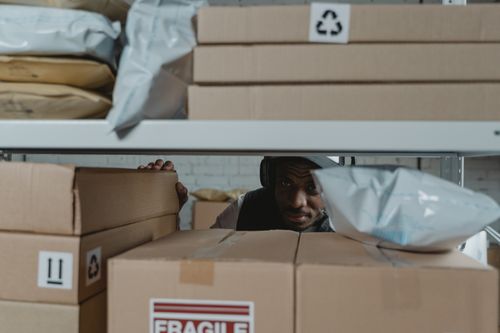
Step 5: Disposition — deciding what happens to the item
Disposition is the decision about where the returned product goes. It is the stage with the most money at stake. The same item can be worth its full price, part of it, or nothing. The decision and its speed settle that.
| Disposition option | When it fits | What happens |
|---|---|---|
| Restock and resell as new | Unused, complete, packaging restorable | Repackaged, returned to stock, sold at full price |
| Resell as open-box or graded | Works, but packaging damaged or light use | Sold at a reduced price, condition stated honestly |
| Refurbish or repair | Fixable fault or missing accessory | Repaired, tested, resold as refurbished |
| Return to supplier | Faulty and covered by supplier terms | Sent back to the manufacturer or distributor for credit |
| Liquidate | Sellable but not worth restocking in the main store | Sold in bulk to a liquidation buyer at a lower recovery |
| Donate | Usable but no practical resale route | Given to a charity or reuse organisation |
| Recycle | Cannot be resold but materials are recoverable | Broken down for material recycling |
| Dispose | Damaged, unsafe, or unsanitary | Destroyed or sent to waste as a last resort |
Sets and bundles need their components checked against the original kit list, with missing pieces replaced before resale — the same discipline used in kitting and fulfillment services, run in reverse.
This short video explains how online stores handle return policies, refunds, and exchanges:
Step 6: Refund or Exchange in Ecommerce Returns Management
The last step settles things with the customer. A refund goes back through the original payment method. For an exchange, the replacement ships when staff authorise the return or when the carrier first scans the parcel. Some retailers wait until the item passes inspection. Each trigger trades speed against risk.
Whichever trigger you choose, state it in the policy and apply it the same way every time. Fast, predictable refunds are a main reason customers buy from the same store again. The stock record must match the grading decision, so the item re-enters inventory management as available, graded, or written off.
Ecommerce Returns Management: What Makes a Good Return Policy
The return policy is the public half of ecommerce returns management. It must be clear enough for customers to trust the store before buying, and firm enough to stay affordable. Return policy best practices come down to clarity on a short list of points:
- The return window — how many days the customer has, counted from delivery, not the order date.
- What can be returned — which categories are excluded and why, such as hygiene or personalised products.
- The condition required — whether items must be unused, tags attached, and what happens if they are not.
- Who pays for return shipping — stated plainly before checkout, not revealed during the return.
- How and when refunds are issued — payment method, trigger point, and a realistic time frame.
- How to start a return — steps the customer can find without contacting support.
Two habits separate good policies from poor ones. Use plain words with no legal fog, and a website policy that matches what staff actually do. A generous policy staff quietly refuse to honour costs more trust than a stricter one applied fairly.
Ecommerce Returns Management: Reducing Returns at the Source
The cheapest return is the one that never happens. Most avoidable online returns come from a gap between what the customer expected and what arrived, and those gaps are fixable.
Fix the product page
Accurate descriptions, honest photographs from several angles, and a clear list of what is in the box help. They remove the most common cause of returns: the product was not what the customer pictured. Show scale against a familiar object where size is not obvious. State materials, compatibility, and limitations directly rather than in fine print. Reviews help too, especially those mentioning fit and sizing — the points that cause returns.
Get sizing and fit information right
For clothing and footwear, fit is the dominant return driver. A size chart with actual garment measurements and guidance on whether the cut runs small or large helps. A fit recommendation tool reduces the guesswork further. Some category returns come from bracketing — ordering two sizes and returning one. Better fit information reduces it; charging for returns changes the behaviour too, at the risk of losing the sale entirely.
Pack and deliver accurately
Damage in transit and wrong-item shipments are returns the retailer caused. Packaging matched to the product, a scan check at packing, and accurate address handling cut both. A wrong delivery costs a second outbound shipment on top, so accuracy pays twice.
Use Return Reasons to Improve Ecommerce Returns Management
Reduction work should start from the data collected at initiation. Group return reasons by product. If oneitem keeps coming back as “smaller than expected,” fix its page; . Ifa batch keeps arriving faulty, raise it with the supplier. Returns data is product feedback the customer paid to send you.
Ecommerce Returns Management: Fraud and Abuse
Returns fraud is when a customer deliberately tricks the returns process to get money or goods they are not entitled to. Common forms include:
- Wardrobing — buying an item, using it for an occasion, then returning it as unused.
- Item swapping — returning an older, cheaper, or broken item in the new one’s box and keeping the new product.
- Empty-box and missing-item claims — claiming a refund for an item never sent back, or saying an item never arrived when it did.
- Fake receipts and price switching — using altered proof of purchase to return an item bought elsewhere or cheaper.
There is also a grey area of abuse that is not outright fraud. It covers ordering with no intention of keeping most of the order. It also covers repeatedly returning worn items within the letter of the policy. Keep the response measured, not harsh. Serial numbers and parcel weight checks catch swaps and empty boxes. Packing photos counter false claims, and clear limits on repeat offenders protect the business without punishing the honest majority.

Ecommerce Returns Management KPIs Worth Tracking
Ecommerce returns management cannot run on gut feeling. A small set of measures, reviewed regularly, shows whether the process is improving or quietly getting worse.
- Return rate by product — units returned divided by units sold, tracked per product and category; one store-wide figure would hide the few products causing most returns.
- Cost per return — total returns-operation cost (shipping, labour, packaging, support time) divided by returns processed: what each return actually costs to handle.
- Time to refund — the time from the customer starting the return, or from the parcel arriving if that is your stated trigger, to the money reaching them. Customers judge the whole experience by this measure.
- Recovery rate — value recovered from returned products (resale, refurbishment, liquidation, supplier credit) against the original value of goods returned: how much product value your disposition decisions save.
Also, track the return reason mix alongside these figures. It is less a target than a diagnostic, telling product, content, and quality teams where to work next. Set targets from your own history. A KPI earns its place when it moves and someone acts, not when compared with another business’s figure.
In-House vs 3PL Ecommerce Returns Management
At some point every growing retailer asks whether to handle ecommerce returns management in-house or through a 3PL. A 3PL is a third-party logistics provider. Neither answer is right for everyone.
Handling returns in-house keeps control with the retailer. Staff who know the products grade returns and make quick human decisions on unusual cases. Returns data stays where product teams can use it. The costs are space, staff time, and management attention. Returns volume is uneven, spiking after holidays and promotions exactly when the warehouse is busiest with outbound orders.
Using a 3PL moves the work to a provider with dedicated returns space, staff, and systems. Capacity flexes with volume, and processing is often faster, since grading and disposition are the provider’s core work. The trade-offs are less control over grading decisions, and tight rules and reporting so standards do not drift. Per-return fees make the true cost very visible.
A common middle path: keep grading in-house for high-value products, where a wrong call is expensive. Send high-volume, low-value returns to a 3PL, where speed and unit cost matter more.
Frequently Asked Questions
What is the difference between ecommerce returns management and reverse logistics?
Reverse logistics is the physical movement of goods from the customer back to the business and onward. Returns management is the wider discipline around . It covers : policy, authorisation, inspection and grading, disposition, refunds, fraud control, and the data used to reduce returns.
Should my store offer free returns?
It depends on your margins and your market. Free returns remove a barrier to buying. The return journey and processing come out of the margin on the original sale. Some stores limit free returns to orders above a set value, to drop-off rather than collection, or to exchanges only. Whatever you choose, price the cost into the product; do not discover it at month end.
How long should a refund take?
As fast as your process honestly allows, with the time frame stated in the policy. Customers object to uncertainty more than to a stated wait. Refunding at the carrier’s first scan is fastest; refunding after inspection lowers fraud risk. Pick one trigger and measure your time to refund against it.
What should I do with returned items that cannot be resold as new?
First, work down the disposition ladder. Sell as open-box or graded stock with the condition stated. Refurbish if the fault is fixable, or return to the supplier if your terms allow. Liquidate in bulk, donate usable items, recycle what is recoverable, and dispose only as a last resort.Decide quickly — returned stock loses value while it waits — and record each decision.
How can a small store manage returns without a returns department?
Keep it simple and written down. Start with a clear policy page and one authorisation step (even a form or email template). Keep a fixed weekly slot for processing arrivals. Add a one-page grading guide and a spreadsheet tracking return rate, time to refund, and what each disposition recovered. Finally, add software and staff when volume justifies it.
In short, returns will always be part of selling online. Handled well, each return is two things at once. It is a customer needing a fair, fast answer, and a product whose remaining value is worth recovering. A clear policy, a step-by-step process, and honest numbers turn an unavoidable cost into a managed one.
