


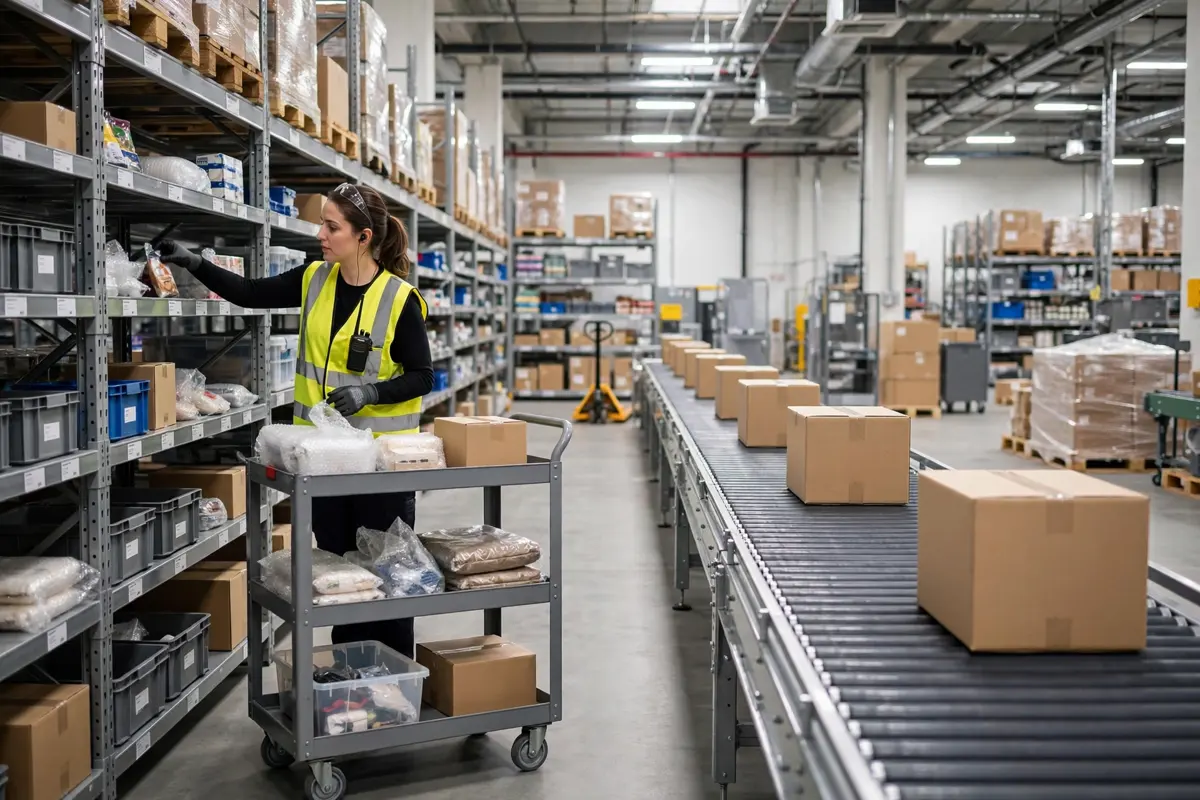
The order fulfillment process is the sequence of steps that moves a product from warehouse stock to a customer’s door. In order, those order fulfillment steps are: receiving inventory, storing it in a known location, processing the order, picking the items, packing them, shipping the parcel or freight load, delivering it, and handling any return that follows. Each step hands clean information to the next one, so a mistake early on — a miscount at receiving, for example — tends to surface later as a missing item, a late shipment, or a return.
Customers judge the result, not the effort behind it: whether the right items arrived, in good condition, and on the date promised. This guide walks through each step, where errors usually start, and how the process changes for ecommerce and B2B orders. It sits inside the broader picture covered in the logistics guide.
Step 1: Receiving Inventory
Fulfillment starts before any order exists. A supplier delivery arrives at the dock, and staff check it against the purchase order and the supplier’s notice of what was sent. They count cartons or pallets, look for visible damage, and confirm that the product codes match what was expected.
Next, each item is recorded in the inventory system, usually by barcode scan. Only after that check is the stock marked as available to sell. If stock is booked in before it has been counted, the system can promise units that are not actually there. If it is counted but left on the dock, it exists on paper yet cannot be picked quickly. Common errors include accepting quantities on trust, mixing similar products during the count, and recording damage without separating the damaged units.
Step 2: Warehousing and Storage
After receiving, workers put stock away in a specific, labelled location — a rack, shelf, or bin that the warehouse system records. This is often called put-away. Pickers later rely on that location record, so a product placed in the wrong bin is effectively lost until someone finds it during a stock count.
Good storage also involves slotting: deciding where each product should live. Fast-selling items usually sit closer to packing and at an easy height to reach. Slower lines can sit further away. Similar-looking variants need clear separation and labelling so pickers do not grab the wrong version. Random put-away and unlabelled locations do not stop an order today. Instead, they slow every pick that follows and raise the chance of a mistake during busy periods.
Step 3: Order Processing
Order processing begins when a customer places an order. The order system checks the details first: items and quantities, delivery address, payment status where that applies, and the delivery option the customer selected. Then it checks stock and reserves — or allocates — units for that order so the same item is not promised twice.
After validation, the system releases the order to the warehouse, often grouped by priority, carrier cutoff, or delivery promise, and creates the pick task. The main failure point is shared stock data. If a website, a marketplace store, and a warehouse system hold different stock figures, overselling becomes likely. Incomplete addresses that pass validation and orders released too late cause problems too.
Step 4: Picking
Picking is the step where a worker, or an automated system in larger sites, goes to the recorded locations and collects the items for an order. Pickers follow a pick list or a handheld scanner that shows the location, the product, and the quantity. A scan at the bin confirms they have the right item before they move on.
Operations pick in different ways. One person might pick a single order at a time. Busier sites often pick items for many orders in one trip and sort them afterwards, or pick by zone so each person works one area. Picking produces more visible errors than most other order fulfillment steps: the wrong product, the right product in the wrong size or colour, and too many or too few units. Similar products stored side by side, skipped scans, and long walking routes under time pressure make those errors more likely.
Step 5: Packing
At the packing station, staff check the picked items against the order one more time. Then they choose a box or mailer that fits, add protection where the product needs it, seal the package, and apply the shipping label. Many operations add a scan at this point as a final check, because it is the last cheap chance to catch a wrong item before it leaves.
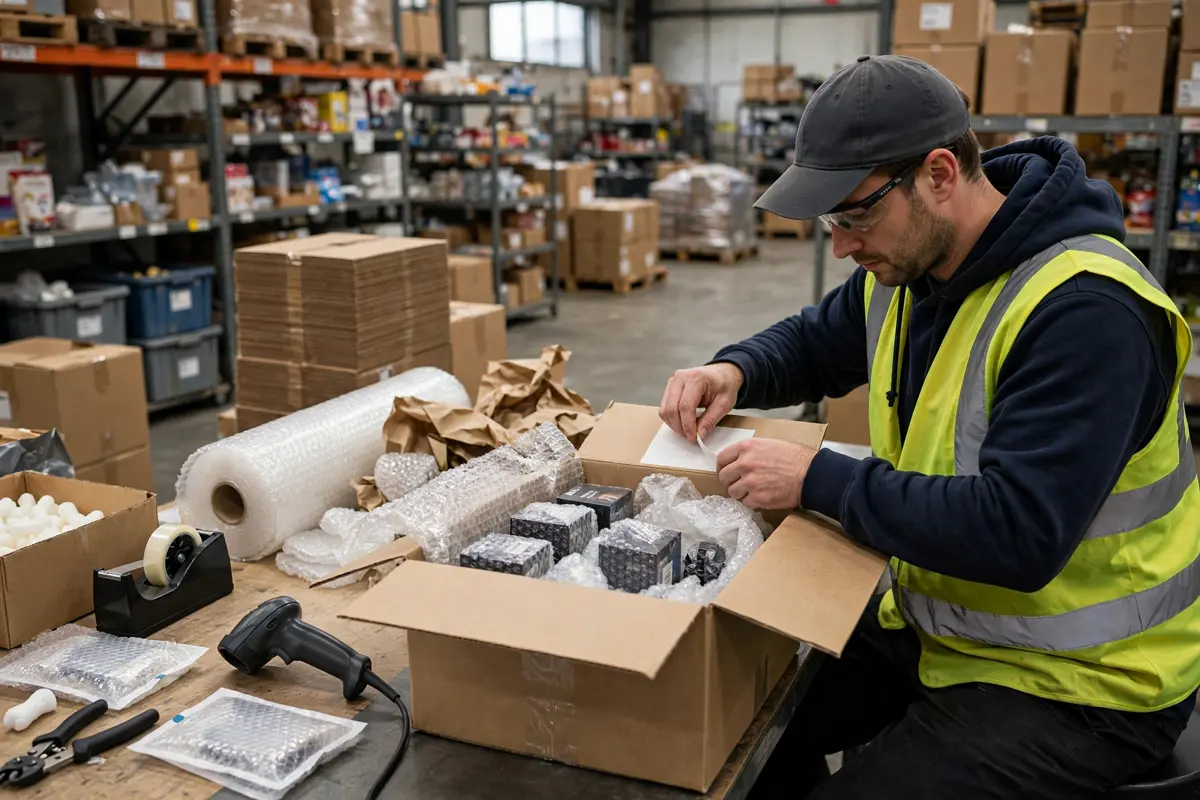
Packing decisions affect cost and damage at the same time. An oversized carton wastes material and can raise shipping charges where carriers price by package size as well as weight. Too little protection does the opposite: the order arrives broken, and the business pays for a replacement and a return. Typical errors include a missing item from a multi-item order, the wrong label on the right box, and packaging chosen by habit rather than by product type.
Step 6: Shipping
Shipping starts when the packed order is sorted by carrier and service level, then handed over at a collection or dock departure. The system records tracking details and sends them to the customer. Staff also work to carrier cutoff times: miss the cutoff, and a parcel that was ready on time still leaves the next day.
Carrier and service choice balances destination, promised date, package size, and cost. Small ecommerce orders usually move as parcels. Larger B2B orders often move palletised as freight, and at that point the choice explained in LTL vs FTL decides whether a shipment shares truck space or fills a truck.
Errors at this step are often administrative rather than physical: the wrong service selected, a label that does not match the carrier manifest, or pallets built without the labels a receiving business requires. Each one can delay a shipment that was picked and packed correctly.
Step 7: Delivery
Delivery is the carrier’s part of the chain, from depot transport through final handover. The fulfillment team’s control is limited here, yet its earlier work still shapes the outcome: accurate addresses, correct labels, and realistic promises set the carrier up to succeed or fail.
During transit, tracking updates flag exceptions such as a failed delivery attempt or an address problem. A clear message with the next step — a redelivery, a collection point, or a corrected address — saves a support contact and often saves the sale. Delivery errors rarely start with the driver. More often, they trace back to a bad address captured at checkout, a label damaged in packing, or a promise the warehouse and carrier could never meet together.
Step 8: Returns Handling
The process does not always end at delivery. A customer may send an item back because it is faulty, damaged, or simply not what they wanted. Returns handling covers receiving the item back, identifying it, inspecting its condition, and then deciding what happens next: restock, repair or repackage where that applies, or disposal if the item cannot be resold.
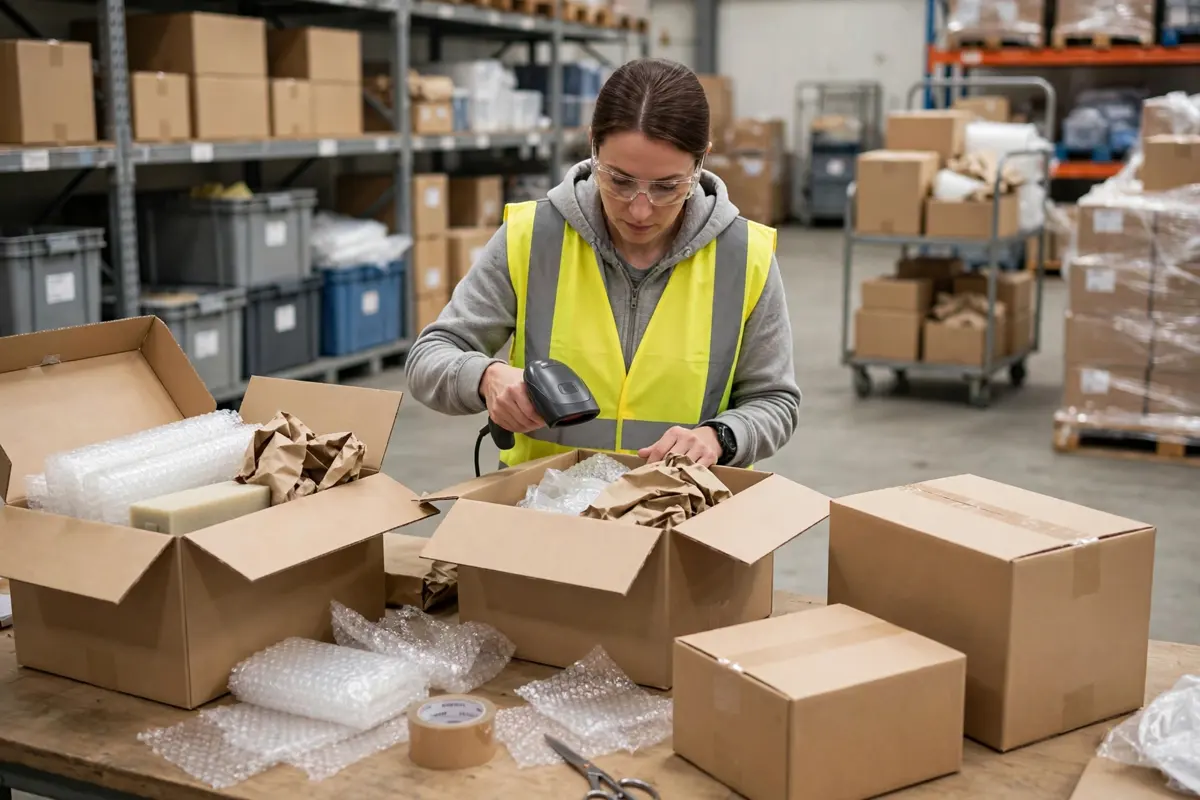
Speed and recording both matter here. A returned item that sits unprocessed is stock the system does not know about, and a refund that waits on that inspection frustrates the customer. A returned item booked back in without inspection creates the opposite problem: the next customer may receive a used or damaged product.
This return flow is part of the wider subject covered in what is reverse logistics, which looks at how goods move backwards through a supply chain, not just forwards.
How the Steps Fit Together at a Glance
| Step | Main job | Error that hurts most |
|---|---|---|
| Receiving | Count, check, and record inbound stock | Booking stock before it is verified |
| Storage | Put stock in a known, recorded location | Put-away in the wrong location |
| Order processing | Validate the order and reserve stock | Overselling from out-of-date stock data |
| Picking | Collect the right items and quantities | Picking the wrong variant |
| Packing | Check, protect, and label the order | Wrong label or a missing item |
| Shipping | Hand over to the right carrier and service | Missing the carrier cutoff |
| Delivery | Move the order to the customer | Bad address data from checkout |
| Returns | Inspect and route returned goods | Restocking without inspection |
Some fast-moving inbound goods skip storage and move straight from receiving toward outbound orders. That shortcut is explained in the guide to cross docking, but most orders still pass through every step above.
In-House vs 3PL: How the Process Changes
The steps stay the same in-house or with a third-party provider. What changes is who does the work, whose systems control it, and where handovers sit.
With in-house fulfillment, the business employs the staff, leases or owns the space, and controls receiving, slotting, and packing rules directly. That control helps when products need special handling. It also means the business carries the fixed cost of space and labour in quiet periods, and must hire and train for busy ones.
With a 3PL, the provider receives and stores stock, then picks, packs, and ships under an agreed process. The explanation of what is a 3PL covers that provider role in full. From a process view, the big differences are integration and visibility: the seller’s store and the provider’s system must exchange orders and stock data accurately, or the same overselling errors appear across two companies. The separate guide to kitting and fulfillment services covers the service side, including added work such as combining products into kits.
How the Process Changes for Ecommerce vs B2B
The workflow is shared, but the shape of an order changes almost every step.
Ecommerce orders are usually small, frequent, and sent to individual customers. One or a few items go into a parcel, and an order may need to be picked within hours of checkout to meet the delivery promise. Returns are a routine part of the model, so returns handling needs its own space and routine.
B2B orders are usually larger, less frequent, and sent to another business. They often arrive as purchase orders, sometimes through electronic data interchange, and may carry specific requirements: pallet labels, carton markings, delivery appointments, or paperwork. Picking often happens by case or pallet rather than by single item, and shipping is more likely to be freight than parcel.
Accuracy matters in both, but the cost of an error differs. A wrong ecommerce parcel disappoints one customer and creates a return. A wrong B2B pallet can hold up the receiving business’s own work, so checks and documentation get more attention before dispatch.
Key Metrics That Show Whether the Process Is Working
Teams usually watch a small set of measures, each tied to a step:
- Order accuracy — the share of orders that arrive complete, correct, and undamaged. It reflects picking, packing, and labelling together.
- Inventory accuracy — how closely system stock records match what is physically on the shelves. Low accuracy explains many failed picks.
- Dock-to-stock time — the time between a delivery arriving and its stock becoming available to sell. Long delays hide stock that the business already owns.
- Order cycle time — the time from order placement to delivery, or in some operations to dispatch. Teams should state which version they use, because the two are not the same.
- Pick accuracy and cost per order — pick accuracy isolates the picking step, while cost per order shows what the whole process costs per order shipped.
- Return processing time — the time from a return arriving to its inspection and decision. It affects refunds and how quickly good stock returns to sale.
Read these as trends, not as targets copied from another operation. A rising dock-to-stock time, for example, points at receiving before it points at picking, even though pickers may feel the effect first.
Frequently Asked Questions
What is the difference between order processing and order fulfillment?
Order processing is one step inside fulfillment. It covers validating an order, checking and reserving stock, and releasing it to the warehouse. Order fulfillment covers the whole chain around it, from receiving inventory into storage through picking, packing, shipping, delivery, and returns.
What happens if an item is out of stock after a customer orders it?
The usual options are to hold the order until stock arrives, split the shipment so available items go first, offer a substitute or refund, or cancel the item. Which option applies depends on the seller’s policy and what the customer agrees to. The process failure sits earlier, though: stock data or allocation let the order through without a unit reserved.
Which software runs the order fulfillment process?
Most operations combine three types of system. An order management system collects and validates orders from each channel, a warehouse management system controls locations, picking, and packing inside the building, and carrier software creates labels and tracking. Smaller businesses may run some of these jobs in one platform, but the jobs stay distinct.
How long does the order fulfillment process take?
There is no single standard time, because the total depends on stock position, cutoff times, warehouse workload, and the delivery service selected. The part a warehouse controls runs from order release to carrier handover. Transit time after handover belongs to the carrier, so the two parts should be measured separately.
Can a small business run this process without a warehouse?
Yes, at low volume many sellers work from a storeroom or a small unit, using the same steps on a smaller scale: check stock in, store it in fixed places, pick against a list, and pack with a final check. The process discipline matters before the building does. Volume is usually what forces a move to dedicated space or a provider.
What is a perfect order in fulfillment?
A perfect order arrives complete, on time, undamaged, and with the correct paperwork or notifications. The idea combines several measures into one customer view. An order can be picked correctly and still fail as a perfect order if it arrives late or damaged.
What are the 5 steps of order fulfillment?
The five core stages are receiving, storage, order processing, picking and packing, and shipping. This guide splits those stages into eight steps in finer detail.

1 Comment
Pingback: Warehouse for Sale: The Complete Guide to Finding & Buying the Right One