


What Are the Parts of a Supply Chain?
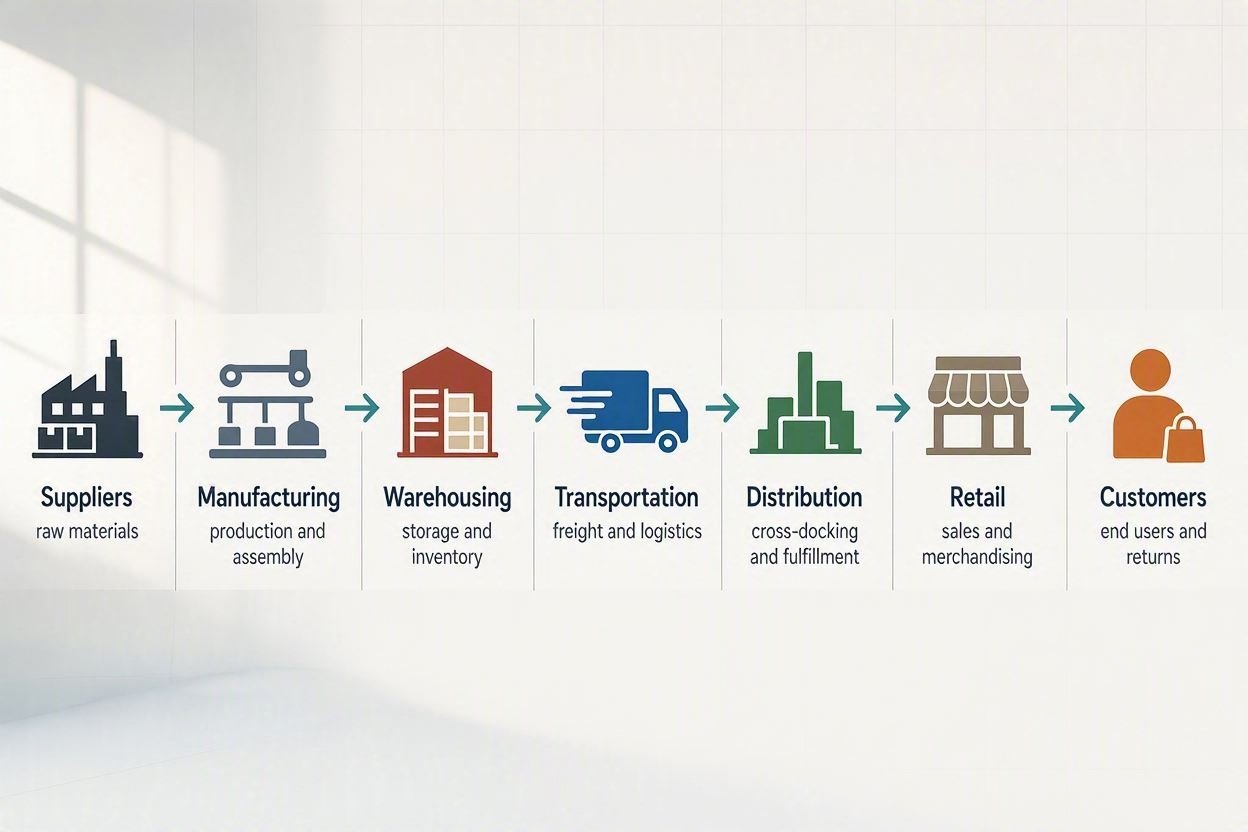
The parts of a supply chain can be understood through five core components: planning, sourcing, making, delivering, and returning. Each one manages a different part of the movement from raw materials to the final customer, while the overall process connects supply, production, inventory, transportation, and customer needs.
The five components work as connected functions rather than separate activities. Planning focuses on customer demand and inventory, sourcing connects businesses with suppliers and raw materials, making turns materials into finished products, delivering manages transportation and final shipping, and returning handles defective, excess, or unwanted items.
From my experience explaining this to people new to supply chain, the confusing part isn’t the five phases themselves — it’s that each phase breaks down into several working components once you look closer. In practice, a single phase like “Deliver” actually covers warehousing, transportation, and order fulfillment as separate day-to-day functions, even though they all serve the same phase. The practical difference is this: Plan, Source, Make, Deliver, and Return are the five phases a product moves through, while the sections below are the components that do the actual work inside each phase. Here’s how they map together:
| Phase | Components Covered in This Article |
|---|---|
| Plan | Planning and Demand Planning |
| Source | Purchasing and Sourcing |
| Make | Manufacturing and Production, Inventory Management |
| Deliver | Warehousing and Storage, Transportation and Distribution, Customer Service, Order Fulfillment and Delivery |
| Return | Returns and Reverse Logistics |
I’ve found that keeping this table in mind while reading makes the rest of the article much easier to follow — each heading below is really just a closer look at one piece of the five-phase picture.
Planning and Demand Planning
Demand Planning
Demand Planning starts with forecasting customer demand. The process uses historical sales data, statistical techniques, current data, and test markets to understand future demand for a product or service. Informal methods such as educated guesses can also be used alongside quantitative methods.
The results can support production planning, inventory management, and decisions about future capacity requirements or whether to enter a new market. Demand forecasting is essentially the prediction of probable demand based on past events and prevailing trends.
In practice, demand planning also requires analytical skills and computer modeling. The work involves analyzing and interpreting data to understand what people will buy, what components you will need, and what trends may affect the sales of your product.
Supply Chain Planning
Supply Planning takes the supply and demand picture and turns it into a strategy. Visibility into every step supports effective planning, helps align supply with demand, and focuses on enhancing efficiency.
Supply chain management professionals consider questions around raw materials, where materials will be sourced, how and where manufacturing will take place, what equipment is needed, and who will handle warehousing and distributing activities. The plan also considers how the product reaches the supplier, retailer, or consumer.
Purchasing and Sourcing
Purchasing
Purchasing is the activity of acquiring goods or services to accomplish the goals of an organization. Its objectives include maintaining the quality and value of a company’s products, minimizing cash tied up in inventory, maintaining the flow of inputs and flow of outputs, and strengthening the organization’s competitive position.
The purchasing function can involve product specifications, receipt and processing of requisitions, advertising for bids, bid evaluation, awarding supply contracts, inspection of goods received, and appropriate storage and release. These activities connect purchasing with the materials and resources needed to create a product.
The roles within purchasing can include a coordinator or analyst, materials manager, and corporate purchasing manager. These roles may exist at a field location, plant, or corporate location, with purchasing activities ranging from office supplies to parts for the construction of airplane engines.
In practice, Boeing’s 787 Dreamliner program is one of the clearest examples of what happens when this function breaks down at scale. Boeing outsourced an unusually large share of the aircraft’s design and manufacturing to suppliers around the world, expecting to shorten production time and cut costs. The practical difference between that plan and how it actually played out came down to purchasing oversight: sections arrived from suppliers incomplete, missing wiring and hardware that were supposed to be finished before delivery, and Boeing had to buy back some of its own suppliers just to regain control of the process. The result was roughly three years of delays and billions in overruns — not because the idea of outsourcing was flawed, but because the purchasing and inspection checkpoints that should have caught incomplete work weren’t strong enough to keep up with the scale of the program.
Sourcing and Procurement
Sourcing and procurement focuses on identifying and purchasing the components required for product assembly. The goal is to maintain quality and reliability while keeping costs in check.
Sourcing involves identifying vendors and suppliers that can provide goods and services efficiently while maintaining quality control and compliance with standards.
Manufacturing and Production
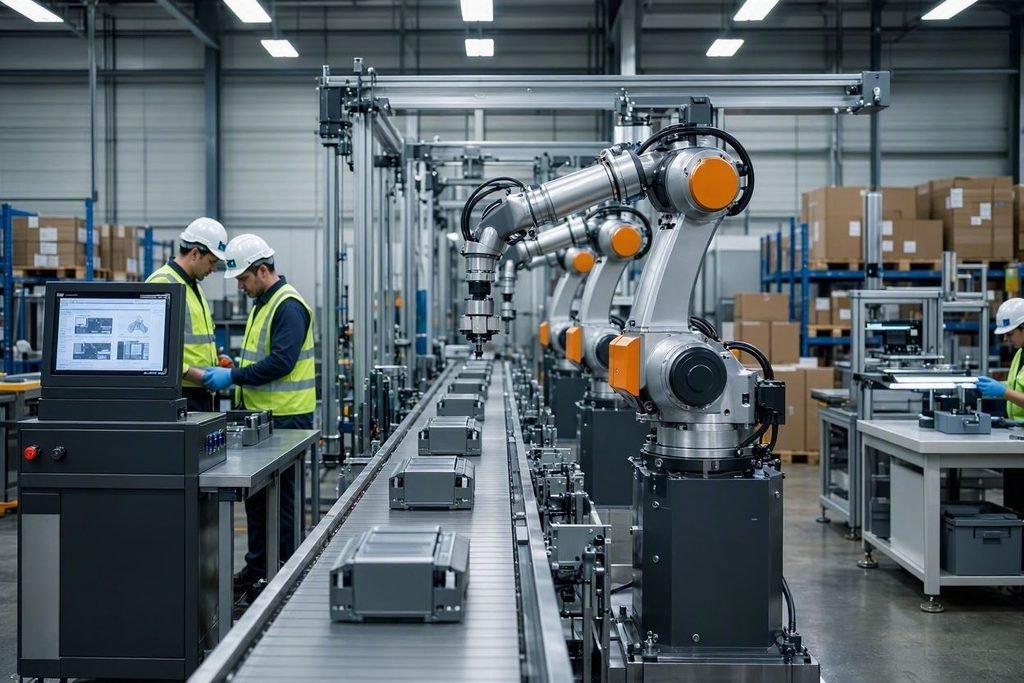
Manufacturing is the production of merchandise for use or sale through labour, machines, tools, chemical and biological processing, or formulation. It can range from handicraft to high tech, with industrial production transforming raw materials into finished goods on a large scale.
Finished goods can become part of more complex products such as aircraft, household appliances, or automobiles, or they can move to wholesalers, then retailers, and finally end users and consumers. Manufacturing also includes roles such as production planner, production manager, plant manager, line operator, machine operator, QA analyst, and engineer.
The manufacturing and production component of supply chain management is the stage where planning and sourcing efforts allow a company to transform raw materials and components into the finished product. Supply chain management professionals oversee in-house production of goods, including product testing, production output, packaging, inventory optimization, and quality assurance.
The core of SCM involves production processes aimed at meeting demand and maintaining inventory levels. Supply chain managers also look for issues and opportunities to fine-tune the sourcing process or manufacturing process.
Inventory Management
Inventory Management involves maintaining the optimum number or amount of each inventory item. Its objective is to provide uninterrupted production, sales, and customer-service levels at the minimum cost.
Inventory can represent a significant part of a company’s current assets category, so inventory problems can contribute to losses or even business failures. In a manufacturing company, physical inventory is an important asset because products need to be available for sales.
The practical focus is having the right product, right place, and right price. In the global economy, the inventory function has become more challenging because products can be produced and available anywhere in the world.
The distribution component of supply chain management also considers how inventory reaches wholesalers, distributors, and retailers. Inventory and warehousing management software and leading-edge technologies help supply chain managers plan the distribution process and make it more resilient and reliable.
From my experience, the “right product, right place, right price” idea sounds simple until you look at how few companies actually pull it off. Zara is one of the clearest examples of getting it right: every garment, regardless of where it’s manufactured, passes through one of the company’s centralized distribution hubs in Spain before being sent out to stores worldwide, twice a week. In practice, that centralization is what lets Zara treat inventory as one connected picture instead of a warehouse-by-warehouse guessing game — when a style starts selling fast in one region, the same real-time data that flags the trend also drives the next replenishment run, instead of that store simply running out while stock sits idle somewhere else.
Warehousing and Storage
Warehousing covers the administrative and physical functions associated with the storage of goods and materials. These include receipt, identification, inspection, verification, putting away, and retrieval for issue.
Warehousing has developed beyond simply storing products. A warehouse can operate as a distribution center and a facility for customizing the final product through repacking, labeling, or physical conversion. Proper handling, storage, and management of products are needed so customer orders can be fulfilled with the right product at the right time.
Warehouse activities include receiving and inspecting materials from other departments or outside suppliers, checking quality and quantity, retrieving and shipping items, and working with inventory and operations managers to maintain an accurate picture of stock levels and utilization rates. Storage facilities also need appropriate safety and security for workers and stored goods.
Warehouse management continues to change through automation, digital record-keeping, and blockchain tracking. These technologies create new opportunities for balancing storage space with fast access to products. Specialized areas include Distribution warehousing, Cold storage, Production warehouses, Packaging automation, and Warehouse management systems.
Transportation and Distribution
Transportation is the movement of goods from one location to another. Its modes include air, rail, road, water, cable, pipeline, and space, while the field can be divided into infrastructure, vehicles, and operations.
Transportation connects the right product at the right warehouse with the customer at the right time. In the global economy, goods may move through a container ship, airplane, train, truck, or uber car before arriving at the customer.
Companies evaluate options based on cost, speed, reliability, and ability to service. Efficient transportation of goods into a business also ensures that raw materials and components are available when needed.
Customer Service
Customer service focuses on ensuring customer satisfaction with a product or service. It can take place during a transaction such as making a sale or returning an item, and it can involve an in-person interaction, phone call, or self-service systems.
Although the customer service function appears at the end of the supply chain, it is not the end of the process. The function works to meet customer needs and ensure the customer receives what they want, when they want it. It can also be the only point of contact a customer has with a company, making the necessary skills and knowledge important for understanding those needs.
Supply chain roles extend across Demand Planning, Purchasing, Manufacturing, Inventory, Warehousing, Transportation, and customer service. Examples include demand planner, demand planning manager, materials manager, production planner, inventory manager, forklift driver, dispatcher, asset manager, brokers, customer service coordinator, VMI analyst, and import/export analyst or manager.
I’ve found that customer service tends to get treated as an afterthought in supply chain conversations, right up until it isn’t. Zappos is a well-documented counterexample: the company built an internal operations system, known internally as Genghis, that ties order entry, purchasing, warehouse management, inventory, and shipping into one system that customer service reps can see directly. The practical difference is that reps aren’t reading from a script or guessing at order status — they have the same operational visibility as the warehouse and shipping teams, which is a large part of why Zappos became known for a level of service other retailers struggled to match.
Order Fulfillment and Delivery
Fulfillment and delivery involve getting products to customers swiftly and economically. This includes order processing, warehousing, and selecting efficient delivery methods.
The Deliver phase manages order processing, warehousing, transportation, and final distribution to customers. The focus is on timely delivery, accurate fulfillment, and a smooth logistics network.
Returns and Reverse Logistics
Reverse logistics covers the returning component of supply chain management. It involves receiving returned products and managing the protocol for assigning refunds. Returns can involve product recalls, damaged products, defective products, or consumer dissatisfaction.
This stage can affect the entire supply chain, particularly when products do not meet quality standards or safety standards. Supply chain management leaders work to identify product issues and coordinate the actions needed to address them.
The Return phase handles product returns, repairs, replacements, and recycling activities. An efficient return system can improve customer satisfaction and reduce operational losses, while digital transformation can support efficiency, cost-effectiveness, and customer satisfaction as a strategic advantage for SCM.
How These Parts Work Together
Phase 1: The Blueprint (Plan)
The Plan phase begins before a physical item exists. Data supports predicting demand, with software using historical sales and market trends to determine how many phones will sell. A master schedule then outlines when to buy parts and when to build.
Planning also includes risk checks for potential bottlenecks, such as chip shortages or shipping delays. This connects the schedule with the practical needs of the other supply chain phases.
Phase 2: Gathering Ingredients (Source)
The Source phase begins when procurement teams trigger the acquisition of materials. Sourcing agents use the plan to determine how many screens, batteries, and microchips to buy, while suppliers receive automated alerts to prepare their operations.
Inbound logistics then moves raw materials from global suppliers into the central assembly factory. This connects sourcing directly with the Make phase.
Phase 3: The Assembly Line (Make)
The Make phase is the Assembly Line where the manufacturing facility operates as the execution hub. Raw materials and components are transformed into finished smartphones through production execution involving robotics and workers.
Quality checks involve testing devices and identifying defects. The factory also provides data feedback on how quickly phones are built, allowing the Plan team to adjust future schedules.
Phase 4: Getting to the Customer (Deliver)
Once a phone passes quality control, it enters the outbound logistics network. Finished phones are packed, barcoded, and stored in distribution centers.
When a retail store or online buyer places an order, fulfillment pulls the item from the shelf. During last-mile transit, couriers, trucks, or cargo planes transport the box to the customer’s doorstep or retail shelf.
Phase 5: Closing the Loop (Return)
The Return phase handles issues after delivery through reverse logistics. If a customer receives a broken phone or wants an exchange, the product travels backward through the supply chain.
At the return center, inspection determines whether the phone should be repaired, recycled for parts, or restocked. If a specific part repeatedly fails, that data goes back to Source to change vendors and to Make to address assembly errors.
The Glue: What Drives the System?
The Trigger (Information) connects the phases through a customer purchase. A purchase at the Deliver stage signals the Plan stage to schedule another unit and tells Source to buy more parts.
The Engine (Money) connects the financial side of the process. Customer cash flows backward to support factory payroll and supplier invoices.
Why Each Part of the Supply Chain Matters
Why PLAN Matters: Prevent Chaos and Waste
Each part of the supply chain acts as a critical link in a chain. If one part fails, the entire system can lead to lost revenue, wasted money, or unhappy customers.
The Plan phase helps avoid dead stock by preventing products nobody wants from being built and stored in warehouses. It also prevents shortages, keeps companies from running out of stock, and helps balance cash flow by buying materials when they are actually needed.
Why SOURCE Matters: Protect Margins and Quality
Sourcing affects the base cost and inherent quality of the final product. Negotiating the best prices for raw materials influences profit margins, while selecting reliable, high-standard vendors supports product quality.
Backup suppliers can also reduce risk if a primary vendor becomes bankrupt or faces a disaster. Product quality, vendor reliability, and cost therefore connect closely within this part of the supply chain.
The practical difference between a business that survives a supplier collapse and one that doesn’t usually comes down to whether they ever bothered to line up a backup. The classic real-world example is Nokia and Ericsson in 2000. A fire at a Philips chip plant in New Mexico disrupted the supply of semiconductors both companies relied on. Nokia had backup suppliers ready. It even redesigned parts of its phones to accept chips from other manufacturers, so production barely slowed down.
Ericsson depended on Philips as its sole chip source. It waited on assurances that the plant would recover quickly. By the time it acted, the delay had already cost the company hundreds of millions in lost revenue and a chunk of market share it never fully recovered.
Why MAKE Matters: Efficiency and Value Creation
The Make phase is where abstract parts become actual value that customers can buy. Efficient manufacturing can reduce scrap material, speed up assembly, and lower production costs.
Factory quality checks help identify defective items before they leave the building. A flexible factory can also respond to demand spikes by scaling production when market trends change.
Why DELIVER Matters: The Face of Customer Satisfaction
Delivery is the stage the final customer sees and experiences directly. Fast, accurate, and undamaged deliveries support brand loyalty and can create happy, repeat customers.
Moving goods quickly from warehouses into stores keeps inventory moving, while smart shipping logistics can reduce costs associated with fuel, driver payroll, and customs fees.
Why RETURN Matters: Recover Value and Retain Customers
A smooth return process can turn a difficult customer experience into a loyal relationship. Refurbishing or recycling returned goods allows companies to recover cash from a lost sale.
Easy, hassle-free returns can build trust with buyers, while tracking returns provides an early warning system for identifying systemic product defects.
What Happens When One Part Fails?
The effects become clear when one part fails. If Plan builds 10,000 blue sweaters while customers want red ones, the mismatch affects the next stages. If Source loses a cheap fabric vendor, the assembly line can stop.
A machinery breakdown during Make can cause a missed holiday shipping deadline. A problem during Deliver can leave a product on a shipping dock while customers cancel orders, while failed Return processes can leave broken items in a warehouse and increase operational problems.
FAQs
What are the main parts of a supply chain?
The main parts can be described through five core phases: Plan, Source, Make, Deliver, and Return. The SCOR (Supply Chain Operations Reference) model framework presents these phases as connected parts of the supply chain, from raw materials to the final customer.
Plan includes demand forecasting, inventory control, and resource planning. Source covers supplier selection, procurement, and delivery tracking. Make includes production, manufacturing, quality testing, and packaging. Deliver covers warehousing, order fulfillment, logistics, and distribution. Return includes defect management, value recovery, customer support, and reverse logistics.
What are the 7 major elements of supply chain management?
The seven major elements are demand planning, procurement, production, inventory management, transportation, warehousing, and information systems. Demand planning uses historical data and market trends, while procurement involves sourcing raw materials or services and selecting reliable suppliers.
Production turns raw materials into finished, saleable goods and includes assembly, quality control, and scheduling. Inventory management balances stock and storage costs, transportation moves goods through the supply chain, warehousing manages receiving and tracking, and information systems connect the parts through shared data and software such as enterprise resource planning (ERP).
What are the 5 pillars of supply chain?
The five core pillars are planning, sourcing, manufacturing, delivery, and returns. Planning manages demand forecasting and resource allocation while setting the overall strategy. Sourcing selects reliable suppliers and acquires raw materials or components. Manufacturing transforms raw materials into finished goods through production, testing, and quality control.
Delivery (Logistics) handles transporting goods, warehousing, and final distribution to customers. Returns (Reverse Logistics) handles product returns, recycling, waste disposal, and customer service claims.
What are the 5 stages of supply chain?
The five stages are planning, sourcing, manufacturing, delivery, and returns. Planning sets goals, manages inventory, and forecasts future customer demand, while sourcing focuses on procurement, reliable vendors, raw materials, parts, supplier relationships, and cost and quality control.
Manufacturing transforms raw materials into finished goods through labor and machinery while maintaining strict quality control. Delivery covers logistics, transport, and distribution to warehouses, retailers, or consumers, with attention to timely, safe, and cost-effective arrival. Returns use Reverse Logistics to handle damaged, unwanted, or recalled items, process refunds, recycle parts, and fix operational errors.

9 Comments
Pingback: XPO Logistics: What It Does, Services, Locations & Tracking - Supply Chain UP
Pingback: XPO Logistics: Services, Tracking, Locations & More
Pingback: SMETA Audit: 2-Pillar, 4-Pillar, Checklist, Cost & Process
Pingback: SQCDP: A Complete Guide to Safety, Quality, Cost, Delivery & People
Pingback: SMETA Extension: Process, Scope & Audit Requirements
Pingback: Capstone Logistics Jobs: Pay, Requirements & How to Apply
Pingback: What Does JIT Mean? Just-in-Time Explained Simply
Pingback: What Is a Logistics Coordinator? Role, Skills & Career Path
Pingback: GOFO Delivery Station: What It Means for Your Package - Supply Chain UP