


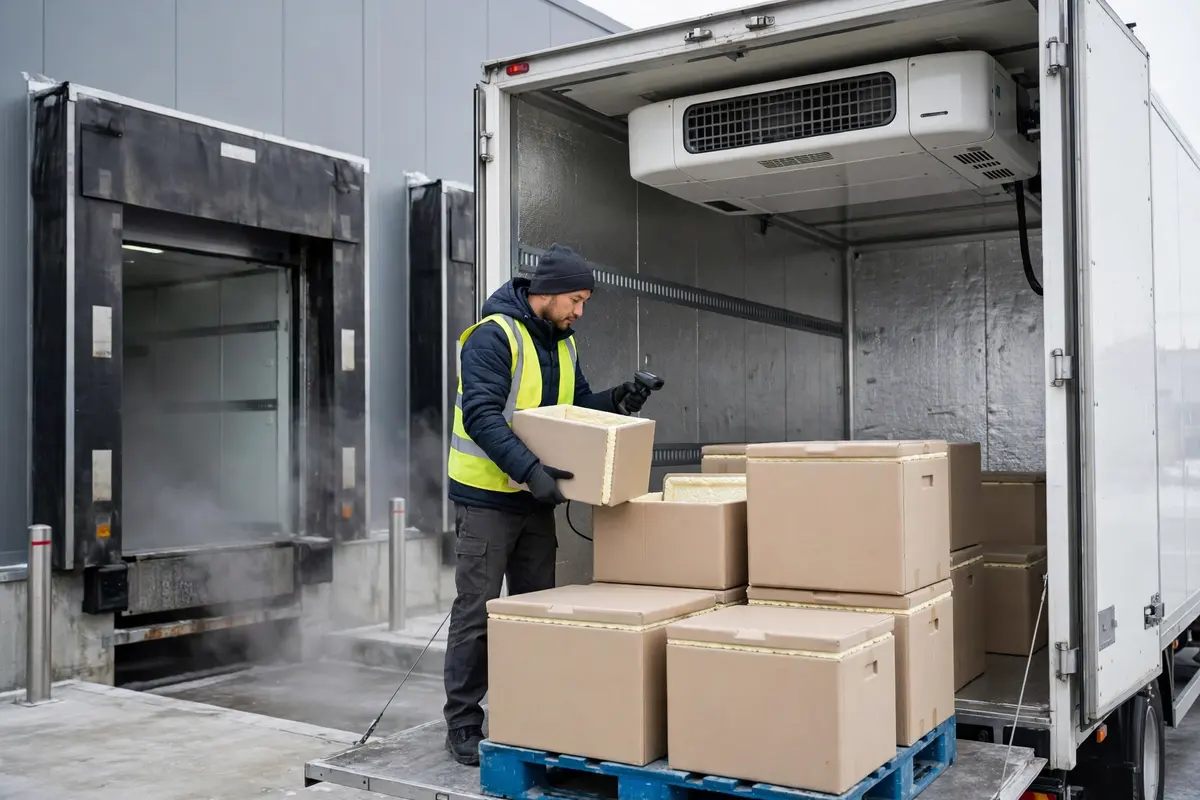
Cold chain logistics is the part of the supply chain that moves and stores temperature-sensitive products inside a set temperature range, with no gaps from the factory to the final user. A vaccine, a pallet of fresh fish, and a shipment of insulin all depend on the same idea: the product stays within its safe range at every stage, in every warehouse, vehicle, and handover in between. The moment the temperature drifts outside that range, the product can spoil, lose strength, or become unsafe to use.
That unbroken run of controlled conditions is what people mean by “the cold chain.” It relies on refrigerated storage, insulated or refrigerated transport, trained handlers, and continuous temperature monitoring. Some products only need to stay cool rather than cold, while others travel frozen or even at ultra-low temperatures near −80°C. The sections below explain how the chain works, which ranges apply to which products, and where breaks happen. This article is part of our complete supply chain guide.
How Does Cold Chain Logistics Work?
Cold chain logistics works by controlling temperature at six connected stages, so the product never sits unprotected between one stage and the next. Each stage uses equipment and checks suited to that point in the journey.
Step 1: Production and pre-cooling
The chain starts the moment a product is made or harvested. Fresh produce is cooled soon after picking, cooked and chilled foods are brought down to storage temperature, and medicines leave the production line under controlled conditions. Pre-cooling matters because refrigeration equipment holds a temperature well but removes heat slowly. Loading warm product into a cold truck forces the unit to fight the load instead of simply maintaining it.
Step 2: Cold storage
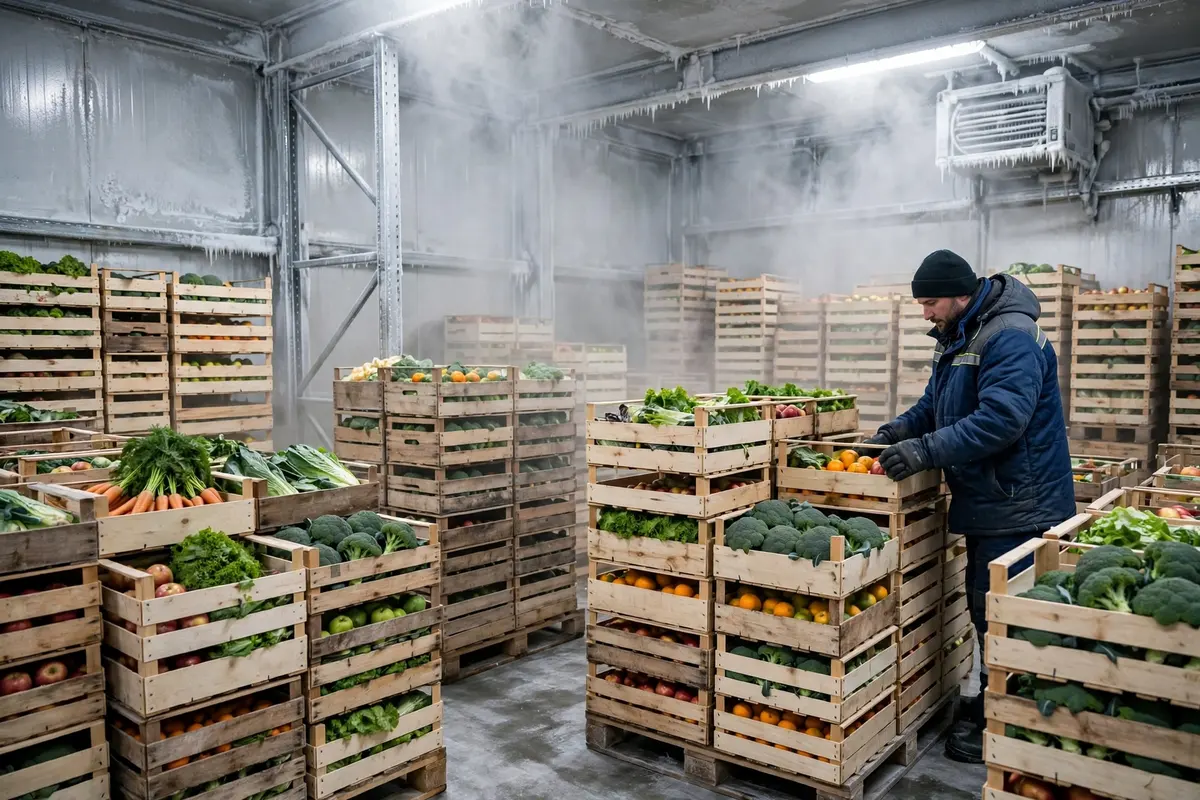
From production, goods move into temperature-controlled storage: cold rooms, refrigerated warehouses, or freezer facilities with separate zones for different ranges. Facilities use monitoring sensors and backup power so a grid failure does not become a product failure. Storage staff also rotate stock so older inventory ships first.
Step 3: Refrigerated transport
Next, the product travels by refrigerated truck, reefer container on a ship or train, or temperature-controlled air cargo hold. “Reefer” is the industry shorthand for a refrigerated unit, whether it sits on a truck trailer or a shipping container. Before loading, crews pre-cool the vehicle and check the set point against the product’s required range. How long this leg takes also feeds directly into the shipment’s overall lead time.
Step 4: Distribution centres and handovers
Regional distribution centres receive, sort, and re-dispatch goods, ideally moving them quickly between cold environments. Handovers are the risky moments here, since pallets may wait on a dock while paperwork or vehicles catch up. Good operators stage loads in cooled areas and keep dock time short.
Step 5: Last-mile delivery
The final leg takes the product to a pharmacy, hospital, grocery store, restaurant, or customer’s door. Control is hardest to maintain here because vehicles are smaller and doors open often. Insulated boxes with gel packs or dry ice often protect this leg instead of a full refrigeration unit.
Step 6: Monitoring from start to finish
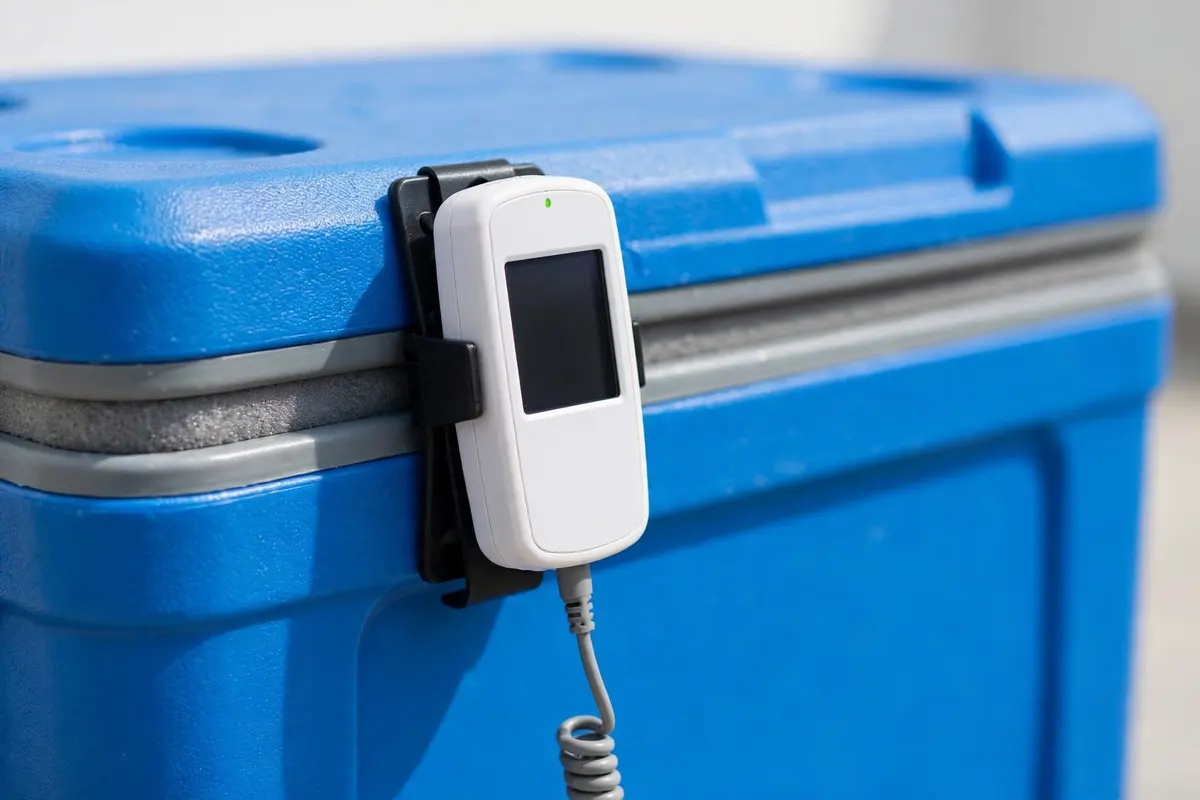
Running through every stage, data loggers and sensors record the temperature around the product. Some loggers store readings for download at delivery, while connected IoT sensors stream data live and send alerts when readings drift. That record is the proof the chain held, which buyers and regulators can ask to see. That live view of conditions in transit is a core part of supply chain visibility.
What Temperature Ranges Does the Cold Chain Use?
There is no single cold chain temperature. Each product has its own validated range, set by its manufacturer or by food safety rules, and the chain is built around that range. The main bands look like this:
| Temperature band | Typical range | Common products |
|---|---|---|
| Controlled room temperature | 15–25°C (59–77°F) | Medicines labelled for room-temperature storage |
| Refrigerated | 2–8°C (36–46°F) | Most vaccines, insulin, biologics, many dairy foods |
| Frozen | −25 to −15°C (−13 to 5°F) | Frozen vaccines, frozen meals, meat, ice cream ingredients |
| Ultra-low | −80 to −60°C (−112 to −76°F) | Certain COVID-19 vaccines and sensitive lab materials |
Refrigerated is the band most people picture. The World Health Organization and regulators such as the FDA use 2–8°C as the standard range for vaccine storage and transport, and the same band covers insulin and many other biologics. Frozen storage suits products built to stay solid, including some vaccines that ship between −25°C and −15°C. Ultra-low storage exists for a smaller set of products, such as certain COVID-19 vaccines that were stored between −80°C and −60°C.
Food follows its own rules within these bands. Under the FDA Food Code, cold time/temperature control for safety (TCS) foods must be held at 41°F (5°C) or below, and the range between 41°F and 135°F is the danger zone where bacteria grow quickly. Fresh produce often sits at the warmer end of refrigeration, while ice cream needs deep-frozen conditions to keep its texture.
One point surprises many people: colder is not always safer. Freezing can permanently damage products designed for the 2–8°C band, including many vaccines and insulin, because ice formation breaks down their proteins. The goal is the right range, held steady, not the lowest temperature available.
What Equipment Keeps the Cold Chain Unbroken?
Cold chain equipment falls into four groups: cooling spaces, cooling vehicles, packaging, and monitoring devices. Every group covers a different weak point in the journey.
Cooling spaces include cold rooms, refrigerated warehouses, blast chillers and freezers that bring product temperature down quickly, and small vaccine refrigerators and cold boxes at clinics and stores. Larger facilities add redundant refrigeration units and backup generators, because a 2 a.m. power cut should not decide a shipment’s fate.
Cooling vehicles are led by reefer trucks and reefer containers, which carry their own refrigeration units and can hold set temperatures across long distances. Air freight uses temperature-controlled cargo holds and specialised containers for high-value, time-sensitive goods such as vaccines and lab samples.
Packaging protects the product whenever it leaves a cooled space. Passive packaging pairs insulation — foam, reflective liners, or vacuum panels — with a coolant such as gel packs or dry ice, and it holds temperature for a limited, tested time. Active packaging goes further: the container has its own powered cooling and temperature controls, which suits longer or riskier journeys.
Monitoring devices tie the system together: the data loggers and live sensors described in Step 6 above, which record conditions through the journey and flag drift early enough to act on.
What Are Some Real Cold Supply Chain Examples?
Cold supply chain examples show up in more industries than food and medicine alone. Four sectors lean on the chain every day:
- Pharmaceuticals and healthcare. Vaccines, insulin, biologics, blood products, and diagnostic samples all travel under tight ranges. A flu vaccine moves at 2–8°C from manufacturer to distributor to clinic fridge, and its potency fades if that range is lost. Some advanced therapies and lab samples go further, down to ultra-low temperatures.
- Food and beverage. Dairy products, fresh meat and seafood, frozen ready meals, and ice cream each sit in different bands of the same system. A grocery chain’s cold chain runs from a farm’s pre-cooling shed to a freezer warehouse, a reefer truck, and finally the store’s cold room.
- Agriculture and flowers. Fresh fruit, vegetables, and cut flowers are cooled right after harvest to slow ripening and wilting. Exporters rely on reefer containers and, for some fruit, controlled-atmosphere containers that adjust oxygen and carbon dioxide as well as temperature.
- Chemicals and cosmetics. Some industrial chemicals, adhesives, and cosmetic ingredients degrade or change behaviour when they get too warm or freeze. Their ranges are usually less extreme than a vaccine’s, but the same storage and monitoring discipline applies.
What Is Cold Chain Management?
Cold chain management is the planning and control layer that sits on top of the physical chain: the procedures, people, and records that keep temperatures where they belong. The US Centers for Disease Control and Prevention describes a vaccine cold chain as three combined elements — transport and storage equipment, trained personnel, and efficient management procedures.
In practice, cold chain management covers a few distinct jobs:
- Setting the rules. Written procedures (often called SOPs) define each product’s range, how to load and unload, and what to do when something drifts.
- Watching the data. Teams review logger records and live alerts, and they investigate gaps instead of filing the data away unread.
- Proving custody. Every handover is documented, so each batch can be traced to a temperature record — the chain of custody auditors and regulators examine.
- Meeting distribution standards. Pharmaceutical chains operate under Good Distribution Practice (GDP) guidelines, and air cargo adds IATA rules for temperature-sensitive goods.
So the difference is simple. Cold chain logistics is the movement and storage itself; cold chain management is how a company plans, monitors, and proves that the movement and storage stayed in range.
What Is a Cold Chain Break, and Where Do Breaks Happen?
A cold chain break — also called a temperature excursion — happens when a product spends time outside its required temperature range. Two details decide how serious a break is: how far the temperature moved, and how long it stayed there. A fridge door left open during restocking is a different event from a failed compressor warming a load for six hours.
Breaks tend to happen at predictable points:
- Loading docks and handovers, where pallets wait in ambient air between a warehouse and a vehicle.
- Loading mistakes, such as placing warm product into a reefer or skipping the vehicle’s pre-cool check.
- Equipment and power failures, including broken refrigeration units, dead batteries, and overnight outages.
- Delays, when shipments sit at customs, in traffic, or on a tarmac longer than the packaging was tested to handle.
- The last mile, where frequent door openings and small, lightly insulated vehicles leave little margin.
What happens next follows a set pattern. Staff quarantine the affected products instead of shipping or using them, then document the excursion: the temperature reached, the duration, and the products involved. A quality team or the manufacturer then assesses the product against its stability data — the tested evidence of how much exposure it can tolerate — and decides whether it can be released or must be destroyed.
A break does not automatically mean the load is ruined. Some excursions fall inside a product’s tested tolerance, and vaccine guidance in several countries even excludes very brief spikes during restocking from counting as a breach. But the assessment only works if the excursion was recorded. Without logger data, the safe default under scrutiny is to quarantine or discard, because nobody can prove the product stayed good. For vaccines, one more rule applies: heat damage is cumulative, and lost potency cannot be restored by re-cooling the product afterwards.
How Can You Keep a Cold Chain From Breaking?
Most prevention comes down to closing the gaps named above, before a load ever moves.
Pre-cool everything. Cool the product, the vehicle, and the storage space to the target range before loading, so the refrigeration unit only has to maintain temperature.
Match packaging to the real journey. Validate insulated packaging and coolant quantities against the full expected transit time, including delays, not the optimistic version of the trip. A shipper tested for 24 hours is the wrong choice for a lane that sometimes takes 48.
Monitor continuously, with alerts. Loggers that only get read at delivery tell you what you lost. Live sensors with alarm thresholds let drivers and dispatchers respond — moving a load, fixing a unit, adding dry ice — while the product can still be saved.
Plan for power and equipment failure. Backup generators, serviced refrigeration units, and a spare-vehicle plan turn a breakdown into a delay instead of a write-off.
Train the people at the handovers. Most excursions start with a person leaving a door open, misreading a set point, or staging a pallet in the wrong zone. Clear procedures and named responsibility at each handover close those gaps.
Write the response plan before you need it. Decide in advance who quarantines stock, who calls the manufacturer, and what data gets recorded. A team improvising during an excursion loses the very details the assessment depends on.
Frequently Asked Questions
What is a cold chain break?
A cold chain break, or temperature excursion, is any period when a temperature-sensitive product sits outside its required range. Severity depends on how far the temperature drifted and for how long.
What temperature do vaccines need to stay at?
Most vaccines must stay between 2°C and 8°C (36–46°F) from manufacture to administration, which is the standard range used by the World Health Organization and the FDA. A smaller number need frozen storage between −25°C and −15°C, and a few, including certain COVID-19 vaccines, need ultra-low storage between −80°C and −60°C.
Does a cold chain break always mean the product is ruined?
No. Products are quarantined and assessed against the manufacturer’s stability data, which shows how much time outside the range they can tolerate. Some excursions fall within that tolerance and the stock is released; without monitoring records to prove what happened, though, quarantined stock is usually discarded.
What is a reefer in cold chain logistics?
A reefer is a refrigerated transport unit — most often a truck trailer or a shipping container — with its own cooling system that holds a set temperature during transit. Reefers handle everything from fresh produce to frozen pharmaceuticals.
How is a food cold chain different from a pharmaceutical cold chain?
The mechanics are the same, but the tolerances and paperwork differ. Food chains follow food safety rules such as the FDA Food Code, which requires cold TCS foods at 41°F (5°C) or below, and the main risk is bacterial growth and spoilage. Pharmaceutical chains work to manufacturer-set ranges under Good Distribution Practice, with stricter documentation, because an out-of-range medicine can lose potency invisibly while looking perfectly fine.
What is the difference between active and passive cold chain packaging?
Passive packaging uses insulation plus a coolant such as gel packs or dry ice, and it holds temperature for a limited, pre-tested period with no power source. Active packaging contains its own powered refrigeration and controls, so it suits longer journeys and products with tighter ranges.
