


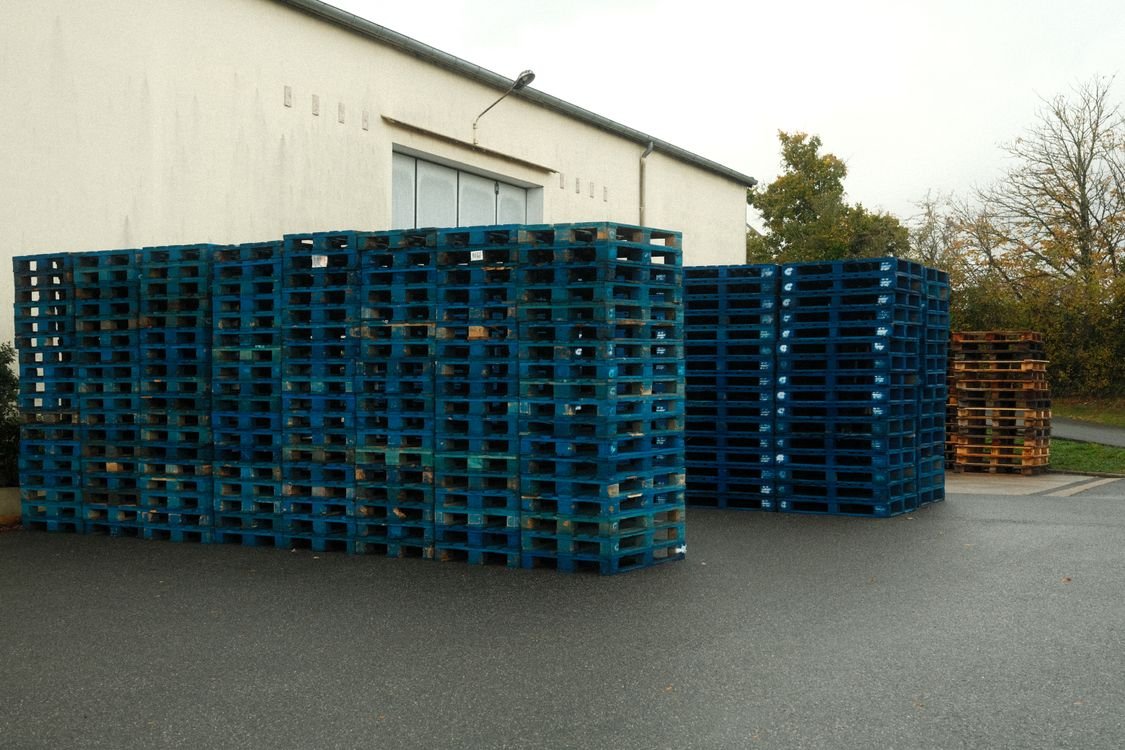
The standard pallet dimensions in North America are 48 × 40 inches (1,219 × 1,016 mm). This is the GMA pallet, set by the Grocery Manufacturers Association. It dominates because it fits US trucks, warehouse racking, and grocery supply chains. Roughly one in three pallets in US circulation follows this spec. This guide covers every standard pallet size, heights, load limits, and how to choose.
What Are Standard Pallet Dimensions?
Standard pallet dimensions are the footprint sizes recognized across an industry or region. In North America, the standard is 48 × 40 inches. In Europe, it is the EUR1 pallet at 1,200 × 800 mm. Each standard defines the full footprint, deck layout, and entry type so pallets fit trucks, racks, and handling equipment everywhere.
A standard pallet is more than two numbers. The full spec covers the footprint, deck board count, entry type, and load rating. These details keep pallets interchangeable across suppliers, carriers, and warehouses. When everyone builds to the same standard pallet dimensions, freight moves faster and damage drops.
The North American benchmark is the GMA pallet. Its spec calls for a 48 × 40 inch footprint, seven top deck boards, and five bottom boards of at least half an inch thick. It offers four-way forklift entry. PalletOne is one of the largest US pallet makers. It lists a typical height of about 6.5 inches and a minimum load capacity of 2,500 pounds. See the full spec on their GMA pallet standards page.
Two builds dominate the market. Stringer pallets use three long boards for support and usually allow two-way entry. Block pallets use nine wood blocks and allow four-way entry. Block designs cost more but handle racking and automation better. Most pooled pallets are block pallets.
Custom sizes exist for drums, machines, and retail displays. But custom pallets cost more and limit your options. Standard sizes are cheaper, easier to replace, and work with pooled fleets. For most shippers, these standard pallet dimensions beat custom.
The GMA footprint also appears in ISO 6780 as 1,219 × 1,016 mm. That makes the 48 × 40 pallet a global citizen, not just a US one. Exporters like it because the same pallet works on both sides of the border.
What Is the Most Common Pallet Size in North America?
The most common pallet size in North America is the 48 × 40 inch GMA pallet. It accounts for roughly 30% of all pallets in US circulation. Grocery, retail, and consumer goods companies built their trucks, racks, and conveyors around it. That installed base keeps it the default choice.
The GMA spec started with grocery. The Grocery Manufacturers Association — now the Consumer Brands Association — set it for food distribution. The size proved so useful that other industries adopted it. Today it is the default for retail, consumer goods, and much of general freight.
It won because of fit. Two 48 × 40 pallets sit side by side in a standard 53-foot trailer. Twenty-six pallets floor-load a trailer with no wasted width. Racking, dock doors, and conveyors followed. Once a whole network is built around one footprint, switching gets expensive.
Pooling locked it in. CHEP’s blue pallets and PECO’s red pallets both use the 48 × 40 footprint. These pooled fleets move millions of pallets through the same retail and grocery networks. That keeps the standard pallet dimensions dominant year after year.
Industry sources commonly report that GMA pallets account for about 30% of all pallets used in the United States. The rest is a mix of other standard sizes, pooled block pallets, and custom builds. For a new shipper, 48 × 40 remains the safest default.
Retailers demand it too. Most big-box distribution centers in the US are tuned for 48 × 40 receiving. Suppliers who ship on the standard avoid chargebacks and dock delays. Compliance with the standard pallet dimensions is often written into vendor routing guides.
What Are the Standard Pallet Sizes in Europe and Worldwide?
The standard pallet size in Europe is the EUR1 pallet at 1,200 × 800 mm. Asia commonly uses 1,100 × 1,100 mm. Australia’s standard is 1,165 × 1,165 mm. North America keeps 48 × 40 inches. These regional standards grew around local trucks, containers, and industries. ISO 6780 lists the six footprints most used in global trade.
Common US standard pallet sizes
This table lists the standard pallet dimensions used across US industries.
| Pallet size (in) | Metric (mm) | Typical use |
|---|---|---|
| 48 × 40 | 1,219 × 1,016 | Grocery, retail, and general freight |
| 42 × 42 | 1,067 × 1,067 | Paint, telecom, and auto parts |
| 48 × 48 | 1,219 × 1,219 | Drums, chemicals, and heavy loads |
| 40 × 40 | 1,016 × 1,016 | Square loads and retail displays |
| 36 × 36 | 914 × 914 | Beverage and compact loads |
| 48 × 36 | 1,219 × 914 | Shingles and roofing materials |
International and ISO pallet sizes
Outside the US, metric sizes rule. Here are the footprints that dominate global trade.
| Standard | Size (mm) | Size (in) | Region |
|---|---|---|---|
| EUR1 (EPAL) | 1,200 × 800 | 47.2 × 31.5 | Europe |
| EUR2 (EPAL) | 1,200 × 1,000 | 47.2 × 39.4 | Europe |
| ISO / GMA | 1,219 × 1,016 | 48 × 40 | North America |
| ISO | 1,140 × 1,140 | 44.9 × 44.9 | Asia-Pacific |
| ISO | 1,100 × 1,100 | 43.3 × 43.3 | Asia |
| ISO | 1,067 × 1,067 | 42 × 42 | Industrial |
| Australia | 1,165 × 1,165 | 45.9 × 45.9 | Australia |
Regional standards grew around local equipment. European trucks and containers suit the 1,200 mm family. Asian ports favor 1,100 × 1,100 mm. Australia uses its own 1,165 mm square. If you ship across regions, match the destination’s standard pallet dimensions to avoid re-palletizing at the port.
A quick note on reading these tables. US sizes are listed as length × width in inches. The rest of the world uses millimeters. Always confirm the unit before you order. A 48-inch pallet and a 1,200-mm pallet are not the same.
How Tall Is a Standard Pallet?
A standard GMA 48 × 40 pallet is about 6.5 inches tall, or 165 mm. A EUR1 pallet is 144 mm tall (about 5.7 inches). These low heights keep stacked loads stable and let double-stacked pallets fit inside trailers and containers. Always include pallet height when you plan trailer cube and rack clearance.
Height is part of the spec too. Standard pallet dimensions include typical heights. Most wood pallets land between 5.5 and 6.5 inches tall, built from half-inch deck boards over three-to-four-inch stringers or blocks.
Metric pallets run a bit lower. The EUR1 stands 144 mm tall, about 5.7 inches. That lower profile suits European trailers and container doors. When you mix fleets, size your racking for the tallest pallet plus its load.
Height eats trailer cube. A standard trailer offers about 110 inches of interior height. A 6.5-inch pallet plus a 50-inch load totals 56.5 inches. Two such stacks reach 113 inches — too tall. Always add pallet height to load height before you plan double stacking.
Rack clearance matters too. Selective racking needs a few inches above the load for safe fork entry. When you spec new racking, use the tallest pallet in your fleet, not the average one.
Stacked pallets add up fast. Five empty 6.5-inch pallets make a 32.5-inch stack. Plan return freight with that number. Lightweight nestable pallets stack tighter, but they cost more per trip.
How Do You Measure a Pallet Correctly?
Measure a pallet by its footprint: length first, then width, in inches. Read 48 × 40 as 48 inches long by 40 inches wide. Measure height from the floor to the top of the deck boards. Then check entry type (2-way or 4-way) and deck style. Note these four specs whenever you order, rack, or ship pallets.
Run these five checks on every pallet you spec:
- Footprint. Measure length first, then width. The stringers run along the length. So 48 × 40 means 48 inches long by 40 inches wide.
- Height. Measure from the floor to the top of the top deck boards. Do not include the load.
- Entry. Check whether forks can enter from two sides or four. Four-way pallets move faster through a warehouse.
- Deck. Count the top and bottom boards. Note the gaps. Wide gaps suit drums and blocks. Tight decks suit small cartons.
- Weight. Weigh the empty pallet. A typical wood GMA pallet weighs 33 to 48 pounds. Heavier pallets cost more to ship.

Record all five numbers on your standard pallet dimensions spec sheet. Share it with suppliers and carriers. Consistent specs cut dock disputes and keep freight claims low.
Common mistakes: reading the size backward, forgetting height in cube math, and assuming all 48 × 40 pallets are identical. Grades and builds vary. Measure the pallet in front of you, not the brochure.
Which Pallet Size Should You Choose?
Choose the pallet size your customers and carriers already use. Ship grocery or retail in the US? Use 48 × 40. Ship to Europe? Use the 1,200 × 800 mm EUR1. Match your racking, doors, and trailer cube. When no rule applies, pick the smallest standard size that holds your load safely.
Start with your customers. If they receive on 48 × 40, ship on 48 × 40. Re-palletizing at the dock wastes labor and damages cartons. Your customer’s dock should drive the decision, not the pallet catalog.
Check your equipment next. Racking depth, dock door width, and trailer cube all favor certain footprints. A pallet that will not enter your rack is a liability, however standard it is.
Consider entry and deck style. Four-way block pallets suit racking and fast handling. Two-way stringer pallets cost less and suit one-way trips. Tight decks protect small cartons. Open decks ventilate produce.
Export adds a rule. Wood packaging for international shipments must meet ISPM 15 heat-treatment rules and carry the stamp. Many suppliers stock pre-stamped GMA and EUR pallets for export lanes.
When no rule decides, pick the smallest standard pallet dimensions that hold your load safely. Smaller footprints cut freight cost and warehouse space. Oversized pallets waste both.
Test before you commit. Run a trial lane with the new size and watch for damage, handling time, and carrier feedback. A small pilot beats a fleet-wide mistake. Measure twice, order once.
Frequently Asked Questions
These are the questions we hear most about standard pallet dimensions.
How much weight can a standard pallet hold?
A typical new GMA 48 × 40 pallet carries a minimum of 2,500 pounds under the GMA guidelines. That is a minimum, not a ceiling. Heavy-duty builds can handle far more in static storage — often cited up to about 4,600 pounds. Dynamic loads on a moving forklift are lower. Always check the grade and build before you load heavy freight.
Pallet grade matters most. Premium and Grade A pallets hold rated loads. Damaged or Grade C pallets do not. Inspect before you stack heavy freight.
What is the difference between a GMA pallet and a EUR pallet?
Size and construction. A GMA pallet is 48 × 40 inches with a stringer or block design. A EUR1 pallet is 1,200 × 800 mm with a block design and a perimeter base. GMA pallets dominate North America. EUR pallets dominate Europe through the EPAL pooling system.
Are pallet dimensions measured in inches or millimeters?
Both — it depends on region. The US industry quotes inches: 48 × 40. Europe and most of the world quote millimeters: 1,200 × 800. Always state the unit. When you convert, use exact math: 48 inches equals 1,219.2 mm, which the industry rounds to 1,219 mm.
What does 4-way entry mean?
It means a forklift or pallet jack can enter the pallet from all four sides. Block pallets and notched stringer pallets offer 4-way entry. Standard two-way stringer pallets accept forks from two sides only. Four-way entry speeds up loading and suits tight warehouse aisles.
How many standard pallets fit in a shipping container?
About 20 (48 × 40) pallets fit in a 40-foot container in a single layer. About 10 fit in a 20-foot container. European boxes take about 24 to 25 EUR pallets in a 40-foot container. These are planning figures — confirm with your forwarder, since loading patterns vary.
What is ISPM 15?
ISPM 15 is the global standard for wood packaging. It requires heat treatment or fumigation of wood pallets to kill pests. Treated pallets carry an IPPC stamp with the treatment code. Most countries refuse unstamped wood pallets at the border. Plastic pallets are exempt.

4 Comments
Pingback: 48x40 Pallet: GMA Dimensions, Specs and Load Capacity
Pingback: Pallet Dimensions Standard Chart: Sizes in Inches and mm
Pingback: How Much Does a Pallet Weigh? Wood & Plastic Weights
Pingback: Pallet Rack Uprights: Sizes, Depths and Capacity Explained - Supply Chain UP