


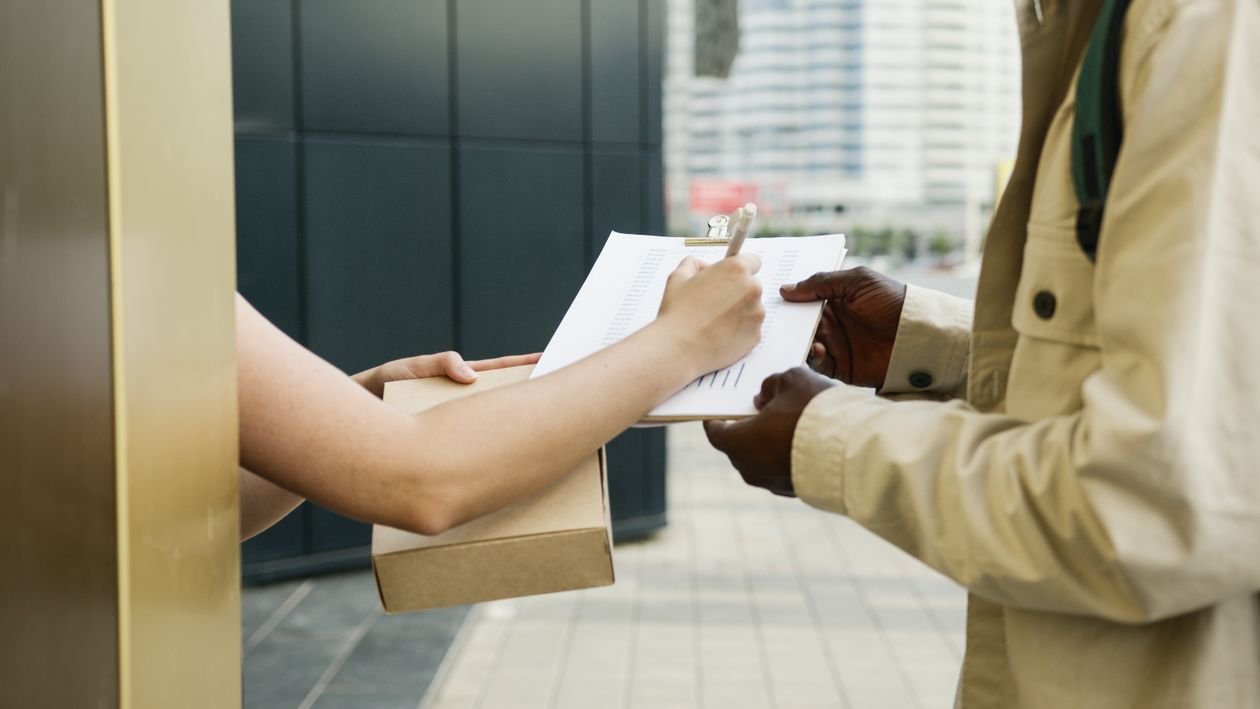
A last mile delivery service takes your parcels from a local hub or store and brings them to your customers’ doors. You hand the parcels to a delivery company, and its couriers do the driving, the doorstep handover, and the updates that keep customers informed. In this guide, you will learn how a last mile delivery service works, what it charges, and how to pick the right one for your business.
For many small and growing businesses, a last mile delivery service makes more sense than running vans and drivers of their own. It removes the need to hire drivers, plan routes, and answer “where is my order” calls all day. Still, the service only works well when you pick a provider that fits your parcels, your areas, and your delivery promise.
What Is a Last Mile Delivery Service?
A last mile delivery service is an outsourced delivery team that handles the final leg of an order. The “last mile” is the trip from a nearby depot, hub, or shop to the customer’s home or office. It is the shortest leg in most supply chains, and it is also the one customers judge most harshly, because it is the only part they see.
When a customer buys from your store, your job ends at the handover point. The provider collects the parcels, sorts them, loads them onto vans or bikes, and delivers them to each address. In return, you pay the last mile delivery service for each delivery it completes, using one of the pricing models explained later in this guide.
Most last mile delivery services also handle the messages around a delivery. They share tracking links, send arrival notes, and record proof of delivery. That way, your customers hear from the courier directly, and your team spends less time chasing updates.
Service vs Software: Hiring a Delivery Team vs Buying a Tool
A service and a software tool solve the same problem in different ways. With a last mile delivery service, you pay another company to move the parcels. With software, you keep the vans and drivers, and you buy a tool to plan their work. So the first question is simple: do you want to run deliveries, or do you want someone else to run them for you?
Outsourcing fits businesses that want delivery without a fleet. You avoid buying vans, hiring drivers, and building a dispatch desk. The trade-off is control. You rely on the provider’s staff, routes, and service hours, so you must choose that provider with care.
Buying a tool fits businesses that already have drivers and want to run them better. A platform can plan routes, assign jobs, and track each van. If your team delivers every day and you want to keep that work in-house, that is the better path. To compare the two options in detail, see our guide to last mile delivery software.
Some businesses mix the two. For example, a shop may use its own drivers in its home city and hire a last mile delivery service for towns farther away. The mix often changes as order volume grows.
Who Uses a Last Mile Delivery Service?
Online shops use these services most, because their customers expect fast home delivery after an online order. A shop with no vans can still offer same-day or next-day delivery in its city by handing parcels to a provider each afternoon.
Grocers and pharmacies use them for a different reason. Their goods are heavy, chilled, or urgent, so they need careful handling and short delivery windows. Restaurants also use couriers for hot food, often through on-demand services that send a rider within minutes.
Direct-to-customer brands use a last mile delivery company when orders spread beyond one city. Instead of opening a depot in each town, they hand parcels to a provider that already covers those areas. In short, any business that ships small parcels to homes can use a last mile delivery service.
Types of Last Mile Delivery Services
The right type of last mile delivery service depends on how fast your customers expect their parcels, and how much care each parcel needs. The main types are below.
Same-Day Delivery
A same-day service collects parcels in the morning or early afternoon and delivers them before the day ends. It suits urgent orders, such as spare parts, gifts, and medical supplies. Because the time window is tight, it works best in one city or a small area.
Next-Day Delivery
A next-day service collects parcels today and delivers them tomorrow. It is the standard choice for most online shops. It gives the provider a full evening to sort parcels and plan routes, so it costs less than same-day delivery and still feels fast to most customers.
Scheduled and Appointment Delivery
A scheduled service lets the customer pick a delivery slot, such as Tuesday between 2 pm and 4 pm. It suits large or valuable items that need someone at home to receive them. Appointment delivery also cuts failed attempts, because the customer knows when to expect the courier.
White-Glove Delivery
A white-glove service adds extra care on top of delivery. The courier may carry the item inside, place it in a room, remove the packing, and take the packaging away. It suits furniture, large appliances, and fragile goods that need two people to handle.
Courier and On-Demand Delivery
A last mile courier service sends a rider or driver for one parcel at a time, often within the hour. You book it through an app or a phone call, and the courier collects the parcel from your shop and takes it straight to the customer. It suits single urgent orders, documents, and hot food.

How a Last Mile Delivery Service Works, Step by Step
From your side, the process is simple. You prepare parcels, hand them over, and watch the tracking updates. Behind that simple handover, a last mile delivery service follows a fixed set of steps. Here is how it works.
- Handover. You pack and label each parcel, then give the batch to the provider at your shop, warehouse, or a collection point. The provider scans each parcel so both sides agree on what was handed over.
- Sorting at the hub. Parcels travel to a local hub, where staff sort them by area and delivery round. Parcels for the same street or suburb go into the same load.
- The delivery run. A courier loads the parcels for one round and drives the route. The provider plans the order of stops so the courier covers the area with as little backtracking as possible.
- Tracking shared with you and the customer. As the courier moves, tracking updates go to your team and to the customer. The customer can see when the parcel is out for delivery and, in many cases, follow it on a map.
- Proof of delivery. At the door, the courier records proof of delivery, such as a signature, a photo, or a note. This record protects both you and the provider if a customer later asks where a parcel went.
- Returns handling. If a customer cannot be reached, the courier follows your agreed rule: leave the parcel in a safe place, take it to a locker, or bring it back to the hub. Returned parcels go back to you with a note that explains what happened.
The video below shows how a crowdsourced delivery run works in practice, from the moment a courier accepts a job to the doorstep handover.
How Last Mile Delivery Services Charge: Pricing Models
A last mile delivery service can charge in different ways, and the model you pick shapes your cost per order. Ask for the full price list before you sign, and ask which surcharges apply to your parcels. The common models are below.
Pay Per Parcel
With pay per parcel, you pay a fee for each parcel the provider delivers. The fee may change with parcel size, weight, and distance. This model suits businesses with low or uneven order counts, because you only pay for deliveries that happen.
Pay Per Route or Per Day
With pay per route, you pay a flat fee for one courier round, no matter how many parcels it carries. With pay per day, you pay for a courier and van for a full day. These models suit businesses with steady, high parcel counts on the same routes each day.
Monthly Contract
With a monthly contract, you agree on a set volume and a fixed monthly fee, often with a lower rate per parcel. This model suits businesses with stable order counts that want predictable costs. Before you sign, check what happens when you send fewer parcels than the agreed count, and what the rate is for extra parcels.
Surcharges to Ask About
Some parcels cost more to deliver. Ask about fees for heavy or oversized parcels, deliveries outside the main area, evening or weekend slots, and failed attempts that need a second visit. A low headline rate can hide these extras, so compare the full cost, not just the base fee.

Outsourced Last Mile Delivery vs In-House Delivery
The table below sums up the main trade-offs. Use it to test which option fits your order count, your budget, and how much control you want.
| Factor | Outsourced last mile delivery | In-house delivery |
|---|---|---|
| Upfront cost | Low: no vans or hiring | High: vans, staff, and tools |
| Control over couriers | Low: the provider manages staff | High: your own team and rules |
| Speed to start | Fast: start within days | Slow: weeks to hire and set up |
| Coverage | Wide: use the provider’s network | Limited: only your own areas |
| Cost when quiet | Low: pay for what you send | High: staff and vans sit idle |
| Peak season | Scales with the provider | Hard: hire extra staff fast |
| Customer contact | Shared: provider talks to customers | Direct: your team talks to customers |
How to Choose a Last Mile Delivery Provider
Choosing a last mile delivery service is mostly about proof, not promises. Ask each provider the same questions, and ask for numbers from their past work. A short trial with a small parcel count can also tell you more than a sales call.
Coverage Area
Check that the provider covers every area you ship to, not just the main city. Ask for a list of postcodes or districts, and ask how they handle addresses at the edge of their area. Gaps in coverage lead to late parcels and manual work for your team.
Delivery Success Rate and Service Promises
Ask what share of first attempts succeeds, and ask how the provider defines “on time.” A clear service promise should state the delivery window, the first-attempt success rate, and what the provider does when a delivery fails. If a provider will not share these numbers, that is a warning sign.
Tracking and Customer Communication
Ask what tracking the customer sees, and when messages go out. Good tracking shows the parcel moving from hub to door, and it warns the customer before the courier arrives. Also ask who answers the customer when a parcel is late: you, or the provider’s support team?
Insurance and Liability
Ask who pays when a parcel is lost or damaged. Some providers cover parcels up to a set value, and some offer extra cover for high-value goods. Get the limits in writing, and check how claims work and how long they take.
Ability to Scale at Peak Times
Ask how the provider copes when your orders double during a sale or a holiday. Can it add couriers at short notice? Does the price change at peak? A provider that plans ahead for peaks will protect your delivery times when you need it most.
Order Handover and Integration
Ask how orders move from your store to the provider. Some providers take a daily file of orders, some link with your shop software, and some accept manual bookings. Pick the method that fits your team, and test it with a few real orders before you switch all of your deliveries.
Once you start, track a few simple measures each week: the share of parcels delivered on time, the share delivered on the first attempt, the share that failed, and the number of customer contacts about late parcels. These four numbers show whether the service is working, and they give you a clear record if you need to raise a problem.
Common Mistakes When Outsourcing Last Mile Delivery
Most problems with outsourcing come from choices made at the start, not from one bad delivery day. Avoid these common mistakes when you hire a last mile delivery service:
- Picking the cheapest quote without reading the surcharges. A low per-parcel rate can hide fees for weight, distance, and failed attempts. Compare the full price list instead.
- Skipping the trial. A short trial with real orders shows how the provider handles your parcels, your areas, and your customers. A sales call cannot show that.
- Leaving delivery rules unclear. If the provider does not know what to do with a missed delivery, each courier will guess. Write the rules down: safe place, locker, or return to hub.
- Forgetting peak season. Order counts can double during a sale. Agree on peak capacity and peak rates before the rush starts.
- Keeping customers in the dark. If customers get no tracking or arrival note, they call your team. Agree on who sends updates and when.
- Ignoring the returns path. Returns are part of delivery. Agree on how returned parcels come back to you, and how fast.
Frequently Asked Questions About Last Mile Delivery Services
These are the questions businesses ask most before they hire a last mile delivery service.
How much does a last mile delivery service cost a business?
It depends on the pricing model, the parcel size and weight, and the distance. Pay-per-parcel suits low order counts, while a monthly contract suits steady high counts. Ask each provider for a full price list with surcharges, and compare the same basket of parcels across providers.
Who provides the vehicles and drivers?
The provider does. A last mile delivery provider supplies its own couriers, vans, or bikes, and it manages their shifts and routes. Your business provides the packed and labelled parcels, and the provider takes it from there.
Can customers track their parcels?
Yes, in most cases. The provider sends a tracking link when the parcel leaves the hub, and it updates the link as the courier moves. Some providers also show the courier on a map and send an arrival note shortly before delivery.
What happens when a delivery fails?
The courier follows the rule you agreed with the provider. Common rules are to leave the parcel in a safe place, take it to a nearby locker, or bring it back to the hub for a second attempt. The provider should tell you and the customer what happened, and the parcel should not sit without an update.
Who handles returns?
The provider usually handles the return trip as well. The courier collects the parcel from the customer and brings it back to your shop or warehouse. Ask how fast returns come back, and whether return trips use the same pricing model as deliveries.
Is a Last Mile Delivery Company Right for Your Business?
A last mile delivery service fits businesses that want fast home delivery without running a fleet. It fits even better when order counts vary, or when you ship to areas you do not know well. It fits less well when you need full control over every courier and every customer call.
Start with a short list of providers, ask each one the questions in this guide, and test the best one with a small set of orders. If the trial runs clean, with parcels on time, customers informed, and returns handled, you can scale up with confidence. For more context on the wider delivery chain, see our guide to last mile delivery challenges.
