


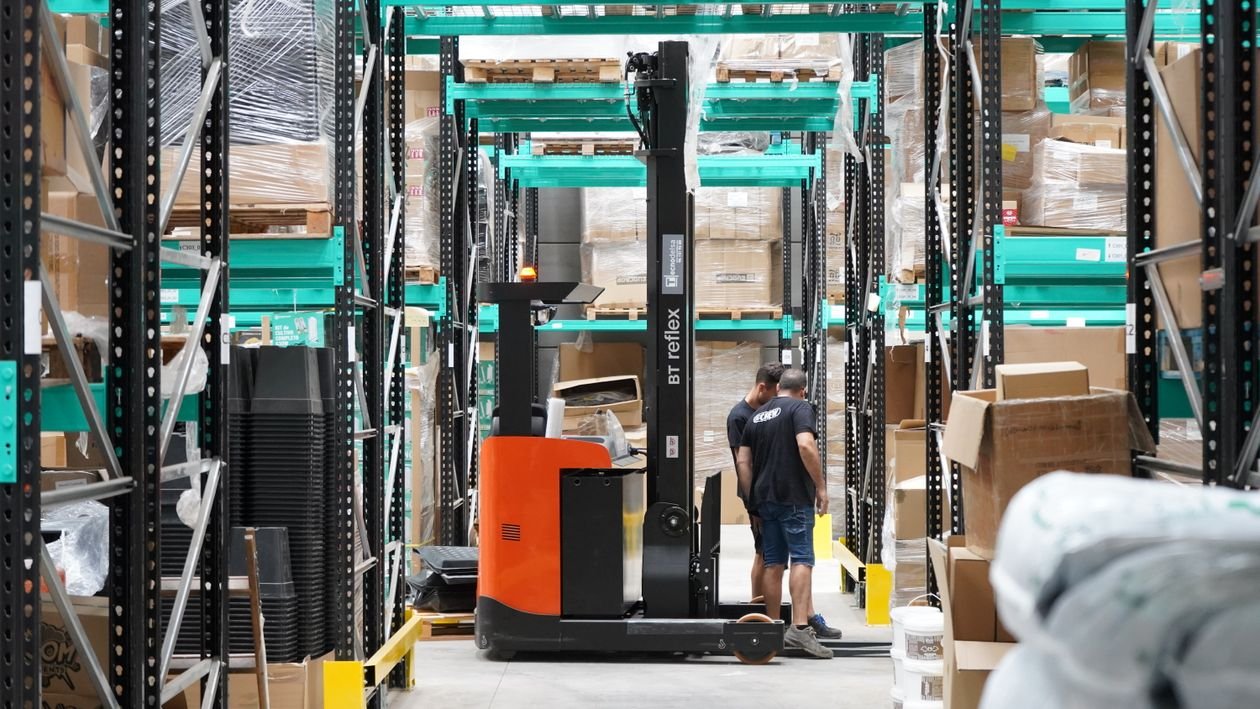
Warehouse inventory management is the control of stock inside a warehouse: receiving goods, storing them in the right locations, picking and packing orders, and keeping the stock record accurate at every step. It is the warehouse half of inventory management. While inventory management looks at stock across the whole business, warehouse inventory management looks at what happens to that stock between the receiving dock and the shipping dock. This guide explains the flow, the controls that keep records accurate, and the systems that support the work.
A warehouse with poor inventory management feels it quickly. Pickers walk to a location and find nothing there. Orders ship short. Stock counts disagree with the system. The warehouse still functions, but every task takes longer and every promise to a customer carries risk. Good warehouse inventory management is mostly unglamorous routine: labelled locations, scanned movements, regular counts. The payoff is that the record can be trusted, and when the record can be trusted, the whole operation speeds up. For the wider context, see our warehouse management and inventory management guides.
What Is Warehouse Inventory Management?
Warehouse inventory management covers the physical handling and the record-keeping of stock held in a warehouse. The physical side is receiving, putaway, storage, picking, packing and shipping. The record side is the system entry for each of those movements, so the stock figure in the system matches the stock on the shelf.
The two sides must move together. A pallet that is put away without being recorded is invisible to the business. A pallet that is recorded but never put away will be promised to a customer who will not receive it. Most warehouse inventory problems are not caused by bad software; they are caused by a gap between the physical move and the record of it. Closing that gap is the core of the job.
Warehouse inventory management also decides how much stock to hold and where to hold it. Fast-moving items sit near the packing area. Slow items sit further back. Heavy items sit low. These choices sound obvious, but in a warehouse that has grown without a plan, they are often wrong, and every wrong location adds walking time to every order. Our warehousing guide covers the building blocks of a well-run warehouse.
The Warehouse Inventory Flow
Stock follows the same path through most warehouses. Each step is a chance to record the movement correctly or to lose track of it.
Receiving
Receiving starts the flow. Goods arrive, are checked against the purchase order, and are counted before they enter stock. Damaged or short deliveries are noted at this point, not discovered later. A clear receiving routine, with a dedicated area and a check against the order, prevents the most common source of record errors: stock that was never counted in properly.
Putaway
Putaway is moving received goods to their storage locations. Each item should have a defined location, and the system should record which location was used. Fixed locations suit stable product ranges; random or dynamic locations suit ranges that change often, because the system directs staff to the nearest free space. Either way, the rule is the same: nothing goes onto a shelf without a scan or an entry.
Storage
Storage is where stock waits for an order. Good storage protects the goods and keeps them reachable. Labels should be readable from the aisle, locations should be marked clearly, and similar items should be stored apart if they are easy to confuse. Stock rotation matters for dated goods: first-in, first-out keeps the oldest stock moving first, which matters for anything with a shelf life.
Picking, packing and shipping
Picking takes items from their locations to fill an order. Pickers follow a route generated by the system, scanning each item as they take it, so the record drops at the moment of the pick. Packing checks the picked items against the order, and shipping records the dispatch. A pick that is scanned is a pick that can be trusted; a pick that is written down from memory is a future stock discrepancy. Some fast-moving operations skip storage altogether and move goods straight from receiving to shipping, a method explained in our cross-docking guide.
Returns
Returns close the loop. Returned goods are checked, graded, and either returned to stock, repaired or written off. The record must be updated at this point too, because a return that sits unrecorded in a corner is stock the business owns but cannot sell. Returns are easy to neglect, which is exactly why they cause so many record errors.

Keeping Stock Records Accurate
Accuracy is the measure that matters most in warehouse inventory management. A record that is 98% accurate still means two items in every hundred are wrong, and those two will be the ones a customer orders. Four practices keep accuracy high.
Cycle counting is the first. Instead of shutting the warehouse for a full annual count, a small sample of locations is counted every day or every week, and the results are compared with the system. Errors are found while they are fresh, and the count routine itself discourages careless handling. Over a year, the whole warehouse is counted several times without ever stopping work.
Barcode scanning is the second. Scanning a location and an item together confirms both the item and the place, and it removes the typing errors that come with manual entry. Where scanning is used at receiving, putaway, picking and counting, the record stays close to reality because every movement is captured at the moment it happens.
Clear location labelling is the third. Every rack, shelf and bin needs a unique, visible label, and the system must use the same labels. If staff invent their own shorthand for locations, the system record and the physical warehouse drift apart.
Investigating differences is the fourth, and the one most often skipped. When a count disagrees with the system, the difference should be investigated, not just corrected. Was the item picked without a scan? Received twice? Stored in the wrong location? Fixing the cause prevents the next error; correcting the number only hides it. This discipline also protects safety stock calculations, which depend on accurate stock figures to work at all.
Common Warehouse Inventory Problems and Fixes
Most warehouse inventory problems fall into a few familiar patterns, and each has a practical fix.
Stockouts happen when the record says stock is available but the shelf is empty, or when the reorder point was set too low. The fix is better counting and a reorder point based on real demand during lead time plus safety stock, not a fixed number that nobody revisits.
Overstock happens when ordering ignores what is already held, or when slow-moving stock is never reviewed. The fix is a regular review of stock by movement: fast, slow and dead. Dead stock should be cleared, discounted or written off, not left to occupy prime locations.
Misplaced stock happens when items are stored in unrecorded locations. The fix is a strict putaway rule: every item is scanned into its location, and locations are checked during cycle counts.
Slow picking happens when fast-moving items are stored far from packing, or when pickers walk the same aisle several times a day. The fix is slotting: place the fastest items nearest the packing area, group items that are often ordered together, and review the layout when the product mix changes. Layout choices are covered in our guide to warehouse automation and modern warehouse design thinking.
Inaccurate records are the root cause behind most of these problems. The fix is the combination above: scanning, cycle counting, clear labelling and investigating differences. No single step is enough on its own.
Warehouse Inventory Management Systems
A warehouse management system, or WMS, is the software that runs the warehouse floor. It directs putaway, generates picking routes, manages locations and records every movement. A good WMS reduces walking time, cuts picking errors and keeps the stock record current, because it records each movement as it happens.
A WMS is not the same as inventory management software. The WMS controls the warehouse; the inventory system controls stock levels across the business. In a small warehouse, one system may do both jobs. In a larger operation, the two connect: the WMS handles the physical work and feeds the results into the inventory record. Businesses using just-in-time inventory management rely on this connection heavily, because small, frequent deliveries leave no room for record errors.
Before buying a WMS, map the current process on paper: how goods arrive, where they go, how orders are picked and how counts are done. A system that matches the real process will be adopted quickly; a system that demands a completely different process will be worked around. Trial it with real stock and real orders, and judge it on the daily tasks, not the demonstration.

Watch: Inventory Management on Video
The video below explains inventory management from the inside of the supply chain: why it matters, the types of inventory, costing methods, control practices and the role of technology.
Frequently Asked Questions About Warehouse Inventory Management
What is the difference between warehouse management and warehouse inventory management?
Warehouse management covers the whole warehouse operation: labour, equipment, layout, safety and throughput. Warehouse inventory management is the part of it concerned with stock: receiving, storing, picking and keeping the stock record accurate. Inventory management is one function inside warehouse management, but it is the function most other decisions depend on.
How often should cycle counts be done?
Count a small sample every day or every week, so the whole warehouse is covered several times a year. High-value and fast-moving items should be counted more often than slow, low-value items. The aim is to find errors while they are fresh, not to count everything at once.
What causes inventory inaccuracy in a warehouse?
The usual causes are receiving errors, picks made without scanning, items stored in unrecorded locations, returns left unprocessed, and damaged stock that is never written off. Most of these are process failures, not software failures, which is why scanning, labelling and cycle counting matter more than a new system.
What is a warehouse management system?
A warehouse management system is software that controls stock inside a warehouse. It directs putaway to the right locations, generates picking routes, records every movement and keeps the stock record current. It connects to the wider inventory system so stock figures stay consistent across the business.
How do you reduce picking errors?
Use barcode scanning at the pick, so the system confirms the right item and the right quantity. Store similar items apart if they are easy to confuse, label locations clearly, and check picks at the packing bench before shipping. Picking errors fall sharply once scanning replaces memory and paper lists.
What is the best way to organise warehouse storage?
Place fast-moving items near the packing area and slow items further away. Store heavy items low and light items high. Keep similar-looking items apart, label every location, and review the layout when the product mix changes. The right layout is the one that shortens walking time for the orders you actually receive.
Putting It All Together
Warehouse inventory management is a routine done well, day after day. Receive carefully, put stock away in labelled locations, scan every movement, count a little every day, and investigate every difference instead of just correcting it. The result is a stock record you can trust, and a trusted record is what lets a warehouse promise delivery dates, keep picking fast and avoid the quiet cost of stock that is there but cannot be found. Get the routine right first, and any system you add on top of it will work far better.
